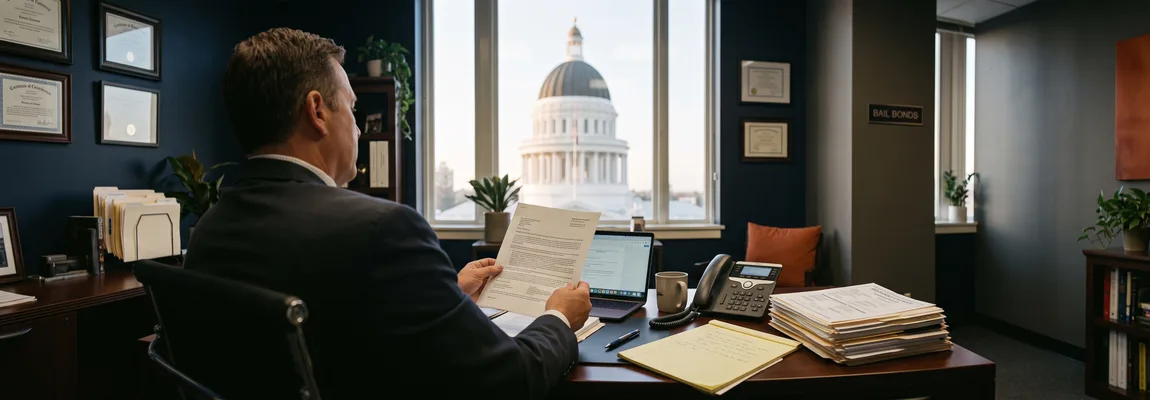
When a bill dies in Appropriations, the industry exhales. Associations call it a win, recovery agents keep working the way they always have, and the SB1026 file goes into a drawer. That reaction is understandable. It is also the moment when the most useful preparation work is cheapest to do.
SB1026 was held in Senate Appropriations on May 14, 2026, and the 2025-2026 session has closed, so California bail fugitive recovery agents and the agencies that hire them operate under the same rules as before: the AB 2043 licensing program and the Penal Code's Bail Fugitive Recovery Persons Act. What comes next is a plausible successor bill in the 2027-2028 session, and the agencies best positioned for it are the ones documenting current-law compliance on every recovery assignment today.
Key Takeaways
- SB1026 is dead for the 2025-2026 session, but none of the gaps CDI cited were fixed: appointment notices still take effect on filing, CDI discipline of recovery agent conduct still generally depends on a criminal conviction, and policy hopping remains common.
- California already requires a lot of bail fugitive recovery agents: a CDI license and California residency, 20 hours of prelicensing study plus a 40-hour POST course, a $1,000 bond, $1 million in liability coverage, and police notice no more than six hours before an apprehension.
- In our read, CDI acknowledgment of appointments and moving conduct rules into the Insurance Code are the provisions most likely to return, while the standalone $1 million insurance mandate is the most likely to be reworked.
- The 2027-2028 Legislature convenes on December 7, 2026, and the bill introduction deadline falls in late February 2027, so agencies will know within months whether recovery agent reform is back.
- Agencies that verify license, insurance, and police notice records on every recovery assignment now are compliant with current law and most of the way to compliance with a likely successor bill.
Where California BFRA Law Stands After SB1026
Nothing in California's bail fugitive recovery framework changed when SB1026 stalled. The rules come from two places: the licensing program AB 2043 created in the Insurance Code, effective July 1, 2023, and the Bail Fugitive Recovery Persons Act in Penal Code section 1299 and following, which governs how apprehensions are conducted.
| Requirement | Current rule | Source |
|---|---|---|
| License | CDI-issued BFRA license on a two-year term; applicants must be California residents | Insurance Code 1802.3; CDI |
| Training | 20 hours of prelicensing study (active bail agents exempt), a 40-hour POST power of arrest course, and 12 hours of continuing education per term | CDI; Penal Code 832 |
| Surety bond | $1,000 bond from a California-admitted surety (active bail agents exempt) | CDI form LIC 437-12 |
| Liability insurance | At least $1 million per loss or occurrence, proven at licensing and at renewal | CDI |
| Authorization | Bail Fugitive Recovery Agent Action Notice, plus a Statement of Bail Employment if employed | CDI forms LIC 437-23B and LIC 438 |
| Police notice | Notify local police or sheriff no more than six hours before an apprehension; telephone notice is allowed, and the name or operator number of the person who took it must be kept | Penal Code 1299.08 |
| Renewal | No late renewals; a lapsed license requires a new application | Insurance Code 1808 |
Two rows in that table matter more than they look. The first is the police notice. Penal Code 1299.08 allows the notice to be given by phone, but it requires the bail agent, depositor, or recovery person to obtain and keep the name or operator number of the employee who received it. Under exigent circumstances, the notice can follow the apprehension instead, and the local department can request a detailed explanation within three working days. It is an easy record to overlook, and an easy one to collect.
The second is renewal. The Department of Insurance does not allow late renewals, so a BFRA whose license lapses must start over with a new application. An agency that keeps assigning work to that person through the gap is relying on someone who is not licensed to do the work.
Which SB1026 Provisions Are Most Likely to Return
CDI sponsored SB1026 because it had identified gaps it could not close through enforcement: appointment notices that take effect on filing, disciplinary authority over recovery agent conduct that generally depends on a criminal conviction, and an insurance structure that lets recovery agents ride temporarily on a bail agent's policy. None of those gaps closed when the bill stalled. The full breakdown of what SB1026 would have required covers each provision in detail. What follows is our assessment of how each is likely to fare in a successor bill, not a forecast from the department.
| Provision | Our read | Why |
|---|---|---|
| CDI acknowledgment before an appointment is effective | Likely to return | Closes the backdating gap CDI cited and is largely administrative |
| Conduct rules moved into the Insurance Code, with CDI fines | Likely to return | Expands the department's own disciplinary authority, the core of what it asked for |
| Written police notice with five-year record retention | Possible | Builds directly on the existing six-hour notice rule |
| Standalone $1 million policy, no policy hopping | Likely to be reworked | Market availability is the central objection, and AB 2043 already lets the commissioner delay insurance requirements over availability or affordability |
| Two-year continuous residency | Uncertain | Current law already requires residency; the added duration is a narrower fight |
Where SB1026 died also matters. It did not fail in a policy committee; it cleared Senate Insurance 5-2 on April 22, 2026. It was held on the Appropriations suspense file, where the committee weighs bills with significant state costs. A successor that asks less of the state budget, or phases in its costliest provisions, would face a different path.
The recovery provisions also sit inside a larger pattern. The same session produced a narrowed solicitation law and a premium refund bill that cleared the Senate before stalling, which our review of California's 2026 bail legislation walks through. Each one moves bail operations toward records a regulator can verify.
The 2027 Legislative Calendar California Bail Agencies Should Watch
The 2027-2028 Legislature convenes on December 7, 2026. Bills for 2027 can be introduced from that day until the introduction deadline in late February 2027, so by early spring agencies will know whether recovery agent reform is back and in what form. Policy committee hearings follow in the spring, and fiscal committees take up their suspense files in May, the same stage where SB1026 was held.
Two signals are worth watching when bills drop. The first is sponsorship: a successor sponsored by the Department of Insurance means the department still treats these gaps as a priority. The second is scope: a bill limited to appointment acknowledgment and conduct rules is a different operational problem from one that brings back the standalone insurance mandate.
Some of this could move without a bill. CDI controls its own forms and filing processes, but moving conduct rules into the Insurance Code and creating new fines takes legislation.
What California Bail Agencies Can Lock Down Under Current Law
The most valuable work right now does not depend on predicting the next bill. It is documenting that every recovery assignment complies with the law that already exists. An agency that can produce this file on request is compliant today and most of the way to compliance with anything a successor bill is likely to require.
- Verify that the BFRA's license is active on CDI's license lookup before every assignment, not once a year.
- Collect proof of the $1 million liability policy and record the carrier, the policy period, and the named insured. If the BFRA is covered under someone else's policy, record that too; it is exactly the arrangement SB1026 targeted.
- Keep copies of the BFRA's action notice and, where it applies, the statement of bail employment.
- For every apprehension, require a record of the police notice: the department notified, the time, and the name or operator number of the person who took it. For exigent cases, record the after-the-fact notice and any explanation provided.
- Track the license renewal date of every BFRA the agency uses, because California does not allow late renewals.
- Store all of it in the bond file, so it can be produced for a surety review or a CDI inquiry without reconstruction.
None of this replaces the judgment an experienced agent uses to decide which recovery professional to trust with a case. It records that judgment, so it holds up when someone else asks.
The other half of the work is reducing how many bonds reach recovery at all. Agencies with disciplined underwriting and risk assessment and an active FTA prevention framework depend less on a recovery market that the next bill could make more expensive. When recovery is needed, the first 30 days after an FTA still decide most outcomes, regardless of what Sacramento does.
Why Waiting for the Next Bill Costs California Agencies More
If a successor bill passes in 2027, a non-urgency California statute typically takes effect on January 1 of the following year. That sounds like time. In practice, agencies that wait for a signature spend that window reconstructing recovery files from memory, while sureties are already asking about recovery vendor vetting. The documentation sureties watch in a tightening regulatory environment overlaps almost entirely with the checklist above.
The agencies that treat SB1026's stall as a permanent reprieve are reading the wrong signal. The ones that build the file now pay for it once, in a quiet year, and arrive at the next bill with records that already answer the questions it will ask.
Frequently Asked Questions
Is SB1026 coming back in 2027?
No successor bill can be introduced until the 2027-2028 Legislature convenes on December 7, 2026, and the introduction deadline falls in late February 2027. Because the Department of Insurance sponsored SB1026 and the gaps it targeted remain, a successor bill is plausible, but it may be narrower than the original.
What insurance do California bail fugitive recovery agents need right now?
A California bail fugitive recovery agent must carry liability insurance of at least $1 million per loss or occurrence for bodily injury, death, or property damage, proven at licensing and renewal, plus a $1,000 surety bond unless already an active bail agent. Current law does not impose SB1026's standalone-policy requirements.
Do California bail recovery agents have to notify police before an apprehension?
Yes. Under Penal Code 1299.08, the recovery agent must notify the local police or sheriff no more than six hours before an apprehension, giving their name, the approximate time and length of stay, and the fugitive's name and approximate location. Telephone notice is allowed, and the name or operator number of the person who took the call must be kept.
Do bail fugitive recovery agents in California have to be California residents?
Yes. The Department of Insurance requires applicants for a bail fugitive recovery agent license to be California residents. SB1026 would have gone further by requiring two years of continuous California residency, but that requirement did not become law.
What should California bail agencies do before the next recovery agent bill?
Verify each recovery agent's license before every assignment, keep proof of their liability coverage with the carrier and named insured, keep their action notice on file, log the police notice for every apprehension, track license renewal dates, and store it all in the bond file so it can be produced on request.
Every recovery assignment should leave a record: license verified, coverage on file, police notice logged. IntelliBail's Recover module keeps that documentation attached to the bond, alongside deadline tracking for every open forfeiture, so the file is ready when a surety or regulator asks.
See IntelliBail Recover →