The licensed bail industry has spent years absorbing the reputational cost of people who were never licensed at all: callers working arrest lists, claiming to represent an agency, pressuring a loved one in the worst hours of their week. Every one of those calls lands on the industry's name. California now treats that conduct as its own crime.
AB1927, signed on September 30, 2026 and effective January 1, 2027, adds Penal Code section 538j. It makes it a crime to impersonate, or falsely hold yourself out as, a licensed bail agent while soliciting bail, and to hire someone to solicit bail while knowing or having reason to know they are doing so. Penalties follow Insurance Code section 1814, with fines up to $10,000 and possible jail time. For agencies already operating inside CDI's solicitation rules, the law adds little burden and removes a category of bad actor.
Key Takeaways
- AB1927 was signed on September 30, 2026 and adds Penal Code 538j, making it a crime to impersonate a licensed bail agent while soliciting bail, effective January 1, 2027.
- The law also reaches anyone who hires a solicitor while knowing or having reason to know that person is impersonating a licensed agent, so licensed agencies should confirm who solicits on their behalf.
- The earlier version's ban on unsolicited contact with arrestee families and its civil penalty schedule were removed before passage, leaving CDI's existing solicitation rules fully in force.
- CDI regulations already limit bail solicitation: the arrestee only after a bona fide request, family and designees only between 7 a.m. and 11 p.m., and no informant arrangements to learn of arrests.
- Penal Code 538j protects reputable agencies more than it burdens them: it targets the impersonators who damage the industry's name, while compliant agencies need only document their solicitation partners.
What AB1927 and Penal Code 538j Actually Do
AB1927, the Bail Consumer Protection Act, was chaptered as Chapter 908, Statutes of 2026, and adds a single section to the Penal Code. Penal Code 538j has two operative parts.
The first makes it a crime for any person to impersonate, or falsely hold themselves out to be, a licensed bail agent and, while doing so, to solicit or attempt to solicit bail. The second reaches the hiring side: it is a crime to hire another person or company to solicit bail while knowing, or having reason to know, that they are impersonating a licensed bail agent and soliciting or attempting to solicit bail.
The statute defines solicitation broadly. It includes, but is not limited to, phone calls, robocalls, text messages, emails, and in-person communications. A licensed bail agent means a person licensed under the bail chapter of the Insurance Code, beginning at section 1800.
Violators are subject to the penalties in Insurance Code section 1814, which makes violations a public offense punishable by a fine of up to $10,000, imprisonment, up to one year in county jail, or both a fine and imprisonment. Those penalties are cumulative: 538j does not displace other law, including the Insurance Code bail chapter and the Department of Insurance regulations written under it.
How AB1927 Changed From a Contact Ban to an Impersonation Crime
The law that passed is much narrower than the bill that cleared the Assembly 78-0 in May 2026. As amended in May, AB1927 would have prohibited bail agents and impersonators from making unsolicited calls, texts, or emails to the family members and known contacts of arrested people, enforced through a civil penalty schedule. The Senate rewrote it.
| Element | May 18, 2026 version | Chaptered law (PC 538j) |
|---|---|---|
| Who it targets | Bail agents and impersonators | Impersonators, and anyone who knowingly hires them |
| Conduct | Unsolicited contact with an arrestee's family or known contacts | Soliciting bail while posing as a licensed bail agent |
| Penalties | Civil: $1,000 to $5,000 for a first violation, $5,000 to $10,000 after that | Criminal: Insurance Code 1814, up to $10,000 and possible jail |
| Enforcement | Attorney General; CDI license discipline | Criminal prosecution, cumulative with existing law |
| Existing CDI rules | Risked superseding them | Left fully in force |
That last row explains the rewrite. The Senate Public Safety Committee analysis warned that the May version would supersede Department of Insurance regulations that already carry criminal penalties, which would effectively lower the penalties for prohibited solicitation. The final law avoids that problem. CDI's solicitation rules keep their criminal teeth, and impersonation gets a statute of its own.
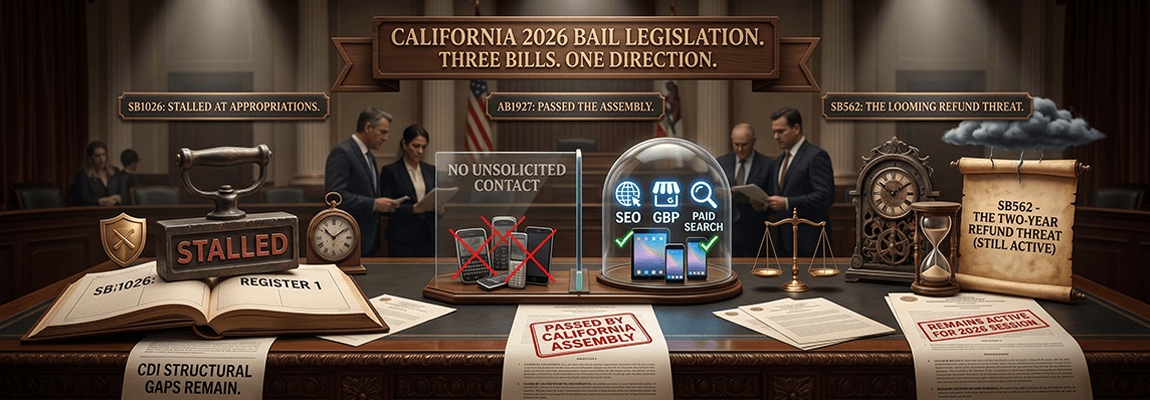
Our earlier review of California's 2026 bail legislation covers how AB1927 sat alongside SB1026 and SB562 in the same session.
The CDI Solicitation Rules Already in Force
AB1927 did not change how licensed agents may solicit. That is still governed by Title 10 of the California Code of Regulations, which the Department of Insurance reminded licensees about in 2023, after the California Supreme Court upheld its informant rule in People v. Martinez.
| Rule | What it requires |
|---|---|
| 10 CCR 2074 | No solicitation in jails, courts, or adjacent areas, except for persons who previously requested bail services, where local rules allow |
| 10 CCR 2076 | No arrangements with informants, including jail staff, inmates, or any other persons, to learn of arrests |
| 10 CCR 2079 | Solicit only the arrestee, the arrestee's attorney, an adult immediate family member, or a person the arrestee designates in writing |
| 10 CCR 2079.1 | The arrestee only after a bona fide request; family and designees only between 7 a.m. and 11 p.m., unless authorized in writing |
| Ins. Code 1814 | Violations are a public offense: fine up to $10,000, imprisonment, or both |
Read together, the picture is clear. Licensed agents solicit within defined limits on who, where, and when. Unlicensed people posing as agents now face a specific crime. The space in between, where someone with no license and no accountability works an arrest list under a borrowed name, is the space the law closed.
Why Penal Code 538j Protects Reputable Agencies More Than It Burdens Them
Impersonators compete for the same loved ones reputable agencies serve, and they compete on the worst possible terms: pressure, misdirection, and no license to lose. When a loved one has been misled by someone claiming to be a bail agent, the damage does not stay with the impersonator. It attaches to the industry, and often to the name of a real agency the caller borrowed. The reputation lifecycle of a bail agency is built over years and can be dented by a single call the agency never made.
Against that, the burden on licensed agencies is narrow. The second part of 538j applies only to someone who hires a solicitor while knowing or having reason to know the solicitor is impersonating a licensed agent. An agency that confirms who is soliciting on its behalf, and what they are saying, meets that standard without changing how it operates.
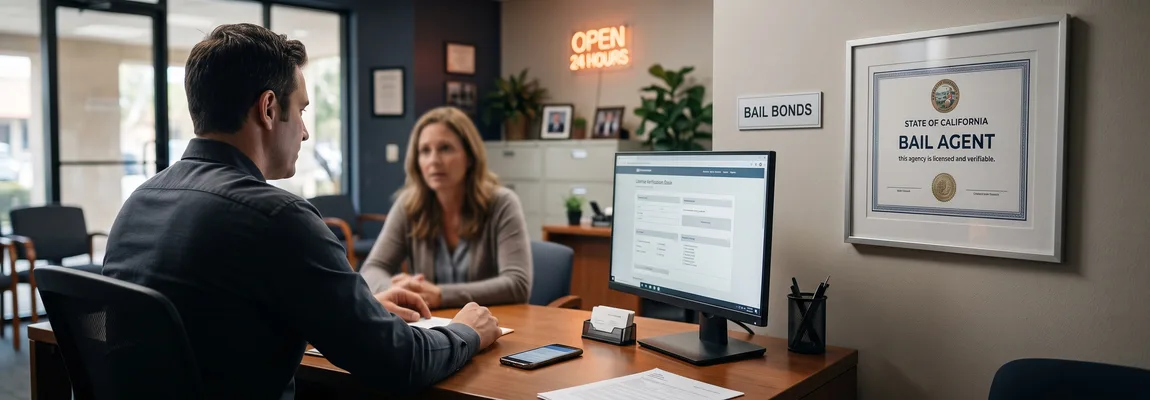
There is a practical upside as well. A loved one who has been warned about impersonators can verify a license through the Department of Insurance's public license lookup. Agencies that display their license number clearly on their website, their Google Business Profile, and their intake scripts make that verification easy, and turn the new law into a trust signal.
A Solicitation Partner Checklist for California Bail Agencies
Most agencies work with outside partners somewhere in the path between a loved one's first search and a signed bond. The checklist below is built from the statute and CDI's regulations, and it applies to any partner whose work touches a loved one before they become a client.
| Partner | What to confirm |
|---|---|
| Lead vendors | Leads come from consumers who reached out, not from arrangements to learn of arrests, which 10 CCR 2076 prohibits |
| Call centers | No one is presented as a licensed bail agent unless they are one, and calls to family members stay within 7 a.m. to 11 p.m. |
| Texting platforms | Every outbound message traces to a documented request or consent, identifies the agency truthfully, and follows the same hours |
| Answering services | Scripts answer inbound calls for the agency without claiming a license the operator does not hold |
| Marketing agencies | Advertising and targeting rely on consumer intent rather than arrest records, and landing pages identify the licensed agency clearly |
Keep the answers in writing, with each partner's contract and scripts on file, and review them whenever a partner changes how it works. The judgment about which partners deserve an agency's name has always belonged to the people running it. The file simply shows that judgment was exercised. For the broader set of records regulators and sureties look for, see the compliance blind spots that get agencies fined or dropped.
Why Consent-Based Messaging Is the Durable Model
Every regulatory move in California's bail market over the last few years points the same way: toward contact that the consumer starts, documented in a way a regulator can verify. The agencies that win in that environment are the ones a loved one finds first and trusts fastest, through local search visibility, responsive phones, and messaging that never gives anyone a reason to question who is on the other end.
Frequently Asked Questions
Is AB1927 law in California, and when does it take effect?
Yes. Governor Newsom signed AB1927, the Bail Consumer Protection Act, on September 30, 2026, and it was chaptered as Chapter 908, Statutes of 2026. It adds Penal Code section 538j and takes effect on January 1, 2027.
Does AB1927 ban bail agents from calling the families of arrested people?
No. An earlier version would have banned unsolicited calls, texts, and emails to arrestee families, but that provision was removed before passage. Licensed agents remain governed by existing CDI rules, which allow soliciting adult immediate family and written designees only between 7 a.m. and 11 p.m., and the arrestee only after a bona fide request.
What are the penalties under California Penal Code 538j?
Violations of Penal Code 538j carry the penalties in Insurance Code section 1814: a public offense punishable by a fine of up to $10,000, imprisonment, up to one year in county jail, or both a fine and imprisonment. These penalties apply in addition to any other applicable law.
Can a bail agency be liable if someone it hires impersonates a licensed agent?
Under Penal Code 538j, it is a crime to hire a person or company to solicit bail while knowing, or having reason to know, that they are impersonating a licensed bail agent. Agencies should confirm who solicits on their behalf, how they identify themselves, and keep those confirmations on file.
Can California bail agents text the family of someone who was just arrested?
Under CDI regulations, a licensed bail agent may solicit an adult immediate family member or a person the arrestee designated in writing, only between 7 a.m. and 11 p.m. unless authorized in writing, and may not use informant arrangements to learn of arrests. Confirm specific practices with counsel licensed in California.
IntelliBail's messaging is never cold and always consented: every contact traces to a loved one's own request, identifies the agency truthfully, and stays inside California's solicitation rules, so every conversation an agency has is one it can stand behind.
See the IntelliBail platform →