
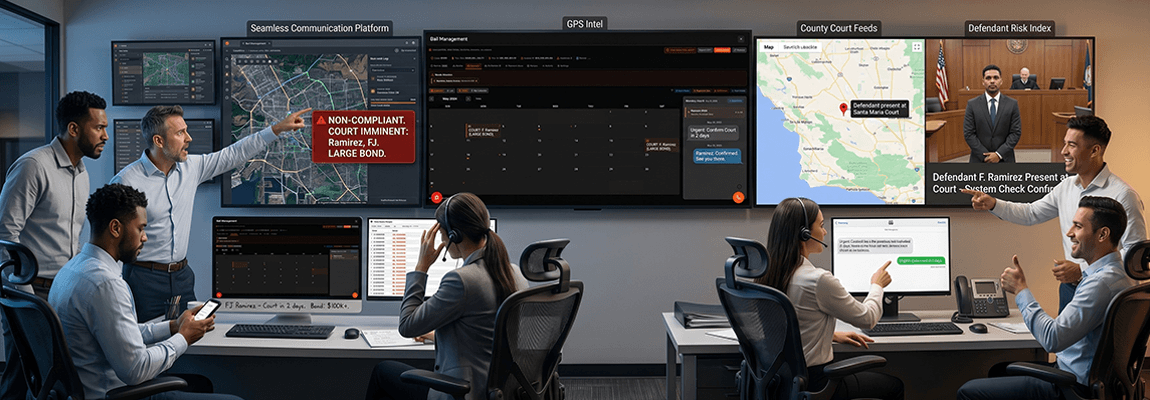
A bail agency's court date calendar tells the agency when each defendant is scheduled to appear. It does not tell the agency whether they are likely to show up. That gap, between what is scheduled and what is probable, is where preventable forfeitures are lost or saved.
The agencies that maintain the lowest failure-to-appear rates are not reacting faster when defendants miss court. They are intervening earlier, in the days and weeks between hearings, when the trajectory is still changeable. The tools that enable that kind of early intervention are not complicated. The discipline required to deploy them consistently is.
Key Takeaways
- Defendants who fail to appear rarely do so without warning; the signals appear between hearing dates, not on the court date itself, and agencies that track only scheduled appearances are missing the window where FTA prevention is actually possible.
- A hearing calendar tells you when a defendant is due in court; a monitoring system tells you whether they are likely to show, and the difference between those two things is the difference between reactive and preventive FTA management.
- The contact cadence between hearings is not a courtesy check-in; it is a structured information-gathering process that surfaces warning signals before they become missed appearances.
- Warning signals that precede nonappearance, including address changes, employment loss, and indemnitor disengagement, are consistently detectable in the days before a missed court date if the agency has a system for finding them.
- Escalation from standard monitoring to active intervention requires defined, objective triggers; agencies that escalate by feel rather than by protocol consistently intervene too late to prevent the forfeiture.
What a Hearing Calendar Tracks (and What It Misses)
A standard court date calendar records the dates, times, and courtrooms associated with each defendant on the agency's active book. That data is necessary and not sufficient. A hearing date is a destination. It does not describe the journey: whether the defendant is currently employed, stable, reachable, still at the address on file, or maintaining the indemnitor relationship that keeps them accountable to the system.
Agencies that treat the hearing calendar as a monitoring system are mistaking a scheduling tool for a risk management tool. Scheduling tells you when. Risk management tells you whether.
This distinction has direct financial consequences. The financial lifecycle of a bail bond extends through seven distinct phases from execution to exoneration, and the phase between hearing dates — post-execution monitoring — is the one where most agencies invest the least structured attention. The assumption that defendants who appeared for their last court date will appear for the next one is not supported by industry data on forfeiture patterns. FTA risk is not uniform across a bond's duration. It spikes under specific conditions, and those conditions are identifiable before a court date is missed.
The Bureau of Justice Statistics pretrial research consistently documents the demographic and situational factors associated with elevated nonappearance risk. Employment instability, housing instability, and weak social ties to the jurisdiction are the structural predictors that show up across studies. All three of these conditions are trackable between hearing dates. None of them are visible on a court date calendar.
The Window Between Appearances
Most court schedules for defendants on bail involve multiple appearances: arraignment, preliminary hearing, pre-trial conference, trial, sentencing. In cases that extend over months, the time between scheduled appearances can span four, six, or eight weeks. During that window, the circumstances that shaped a defendant's risk profile at intake can change substantially.
Employment can be lost. Living arrangements can dissolve. The relationship between the defendant and the indemnitor can deteriorate. A defendant who was a manageable risk on the day the bond was written can be a materially different risk by the next court date if the conditions stabilizing them have shifted. The agency holding that bond does not know this unless it is looking.
The FTA prevention framework that distinguishes low-forfeiture agencies from the rest operates primarily in this window. It is not about what the agency does on the day of court. It is about what the agency knows and does in the 30, 60, or 90 days before each appearance. Agencies that understand this design their workflows accordingly. Agencies that do not are managing by hope rather than by information.
The window between appearances is also where the economics of prevention versus recovery diverge most sharply. Preventing an FTA costs phone calls, a structured contact cadence, and attentive monitoring. Recovering from one costs skip tracing, recovery resources, legal fees, reserve erosion, and surety relationship damage. The true cost of a forfeiture is almost always larger than the bond face value when the full picture is accounted for. Most of that additional cost is incurred in the recovery phase. A monitoring system that prevents the FTA avoids the recovery cost entirely.
The Contact Cadence Framework
Effective between-hearing monitoring requires a defined contact cadence: scheduled touchpoints with both the defendant and the indemnitor at specified intervals between each court date. The purpose of these contacts is not to remind the defendant of their hearing date. It is to gather current information about the conditions that determine whether they will appear.
A structured cadence for a defendant with a court date 60 days out might look like this: initial post-bond contact within the first week to establish the monitoring relationship and verify current contact information, indemnitor contact at day 15 to assess household stability and confirm continued engagement, defendant contact at day 30 to surface any employment or housing changes, and an escalated review at day 45 if any warning signals have emerged in prior contacts. The intervals and parties contacted should vary by risk tier established at underwriting: a defendant assessed as elevated risk at intake requires a tighter cadence than one assessed as lower risk.
The indemnitor communication strategy that drives better recovery outcomes operates on the same principle: contact is not reactive, it is scheduled, structured, and designed to surface problems before they become crises. Agencies that wait for a missed court date to initiate indemnitor engagement are not monitoring risk. They are logging failures. The first meaningful indemnitor contact after an FTA is structurally late: the problem has already materialized, the summary judgment clock has started, and the recovery window is already shrinking.
Critically, the value of a between-hearing contact is not in the outcome when everything is fine. It is in what the contact reveals when something is wrong. An indemnitor who is evasive at day 15 is signaling something. A defendant whose phone number is no longer valid at day 30 is signaling something. An agency that is not making that day-15 contact does not know what it is missing, which means it cannot act on information it never collected.
Warning Signals That Precede Nonappearance
The signals that precede a missed court date are consistent across cases. Employment loss is among the most reliable leading indicators: defendants who lose their jobs in the period between hearings face reduced accountability to a fixed schedule and reduced financial stake in resolving the case. Address instability is another: a defendant who has changed addresses, is couch hopping, or whose original address has become invalid is exhibiting a pattern closely associated with elevated nonappearance risk. Indemnitor disengagement is a third: when the person who co-signed the bond becomes difficult to reach or expresses reduced commitment to enforcing the defendant's court compliance, the accountability structure that keeps most defendants compliant has eroded.
Additional warning signals include: defendant evasion of scheduled contacts without explanation, expressed anxiety or hostility about case outcome that is increasing between hearings, court date changes the agency learns about late or indirectly through the court rather than the defendant, and any new arrest or law enforcement contact in the period between appearances. None of these signals individually constitutes a confirmed FTA risk. Two or more in combination define a risk profile that warrants a changed response protocol before the next court date.
The data on why bonds forfeit at the portfolio level identifies these same variables as the leading structural predictors of FTA. The agencies that maintain the lowest forfeiture rates are not writing better risks at intake, though underwriting discipline matters. They are detecting elevated risk profiles earlier, when intervention is still possible, rather than discovering them when the court date is missed and the recovery process has to begin from scratch.
One pattern worth understanding: defendants who fail to appear are not usually doing so impulsively on the day of court. They are making a decision or failing to manage a situation over a period of days or weeks. The warning signals described above are visible manifestations of that process. An agency with a between-hearing monitoring system is not predicting the future; it is reading a trajectory that is already in motion.
Escalation Triggers That Cannot Wait
The difference between a monitoring system and a prevention system is the escalation trigger: a defined condition that automatically changes the agency's response protocol for a specific defendant before their next court date.
Agencies that operate by feel escalate when the situation seems serious enough or when the agent assigned to a case decides additional steps are warranted. That approach produces inconsistency. Different agents have different thresholds. High-volume periods suppress escalation. Cases that are not actively causing problems receive less attention regardless of their underlying risk signals.
A protocol-driven escalation approach removes that variability. When two or more warning signals are present simultaneously, the case moves to active intervention: direct outreach to the indemnitor with a formal accountability conversation, increased contact frequency with the defendant, and notification to the agency's recovery capacity that the case requires closer attention before the court date. The protocol runs regardless of agent workload, the defendant's prior compliance record, or the agency's informal assessment of whether the situation really warrants it. The protocol is the answer to all of those questions.
The fugitive recovery framework that low-loss agencies operate starts well before a defendant misses court. The first 72 hours after an FTA are the highest-leverage window for locating a defendant, but agencies with the best recovery records are not starting their recovery process at the FTA. They have already escalated, already made intensive contact, and already positioned the indemnitor as an active participant before the court date. The escalation protocol described here is not separate from recovery operations. It is the front end of the same system.
Building the Between-Hearing System
A between-hearing monitoring system requires three components to function: a structured contact cadence with defined touchpoints, a warning signal checklist that all agents apply consistently, and an escalation protocol with objective triggers rather than agent discretion.
The contact cadence should be calibrated to the risk tier established at underwriting. High-risk cases require tighter contact intervals and lower escalation thresholds. Lower-risk cases require less intensive monitoring but still require monitoring. The default should be scheduled contact at regular intervals, not contact only when a problem has already surfaced.
The warning signal checklist does not require new information sources. Every agency already collects defendant and indemnitor contact information, employment data, and housing information at intake. The question is whether that information is systematically updated between hearings, and whether changes to it trigger defined responses. An agency that collected an employment address at intake but has not verified current employment by the midpoint of a two-month monitoring window does not have current risk information. It has initial information that may no longer be accurate.
The operational infrastructure that makes systematic monitoring possible is the same infrastructure that drives lower forfeiture rates across the full book: defendant and indemnitor records that are updated through structured contact, hearing calendars with risk-tier fields attached to each open case, and escalation workflows that surface cases approaching critical thresholds before those thresholds are crossed. The agencies running at half the industry forfeiture rate are not doing more work. They are doing the same work earlier, and doing it according to a system rather than by feel.
A hearing calendar and a monitoring system are not the same thing. The Recover module tracks every open case in your book against its hearing schedule, surfaces warning signals from defendant and indemnitor contact records, and structures the escalation sequence from first contact through court date. The information exists. The question is whether it is organized where you can act on it.
See how Recover works →