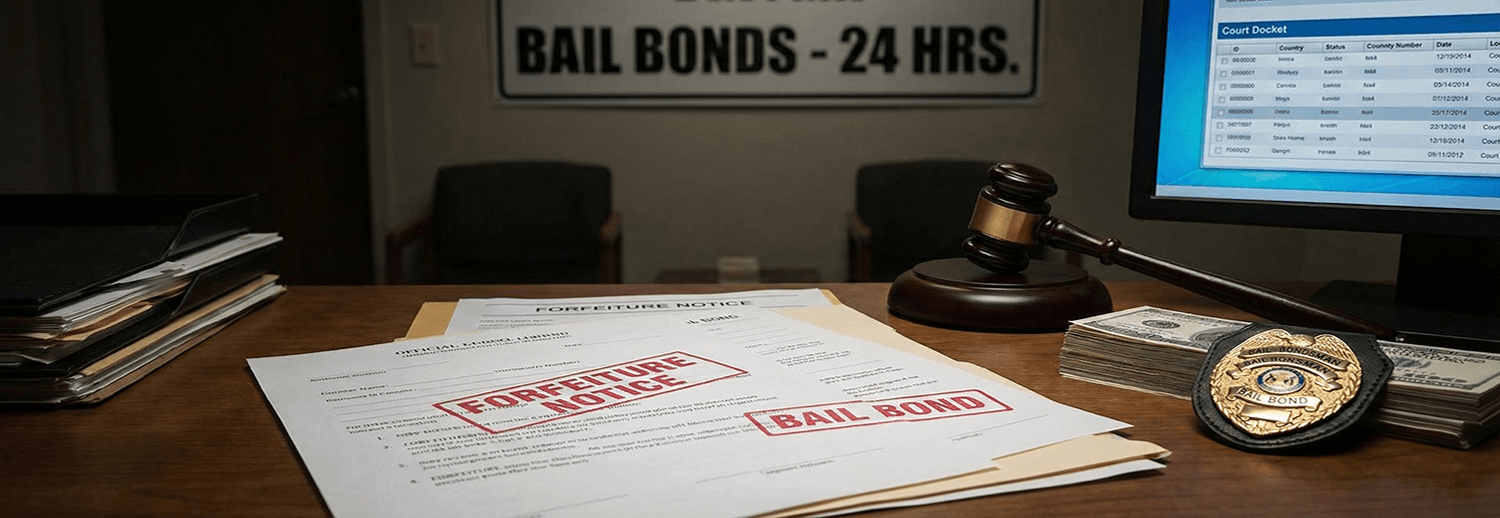
There is a number that every bail bond principal knows but rarely says out loud. One in ten. Bureau of Justice Statistics data on felony defendants shows roughly one bond out of every ten written will fail to complete its court calendar. The defendant will miss a date, the court will issue a forfeiture notice, and your agency will be on the clock to produce them or write a check.
Most agencies treat that number as a tax. A cost of doing business. Something that happens to them. The agencies worth studying treat it as a problem with a solution.
Key Takeaways
- Forfeiture is not random; it follows observable patterns that begin at signing and compound through the bond lifecycle.
- The true cost of a forfeited bond is multiples of the premium collected: manhunt costs, recovery overhead, attorney fees, and capital tied up during the appeal period all stack.
- The post-signing week is the highest-value intelligence window in bail; behavioral signals set then predict outcome better than any underwriting factor.
- Indemnitor relationships maintained with consistent low-friction touchpoints through the bond term are the fastest recovery asset when a defendant FTAs.
- Low-forfeiture agencies treat every active bond as a live operational file from execution to exoneration, not a completed transaction filed away at signing.
The Cost of Treating Forfeiture as Inevitable
The word "inevitable" is doing a lot of damage in the bail industry. When an agency internalizes forfeiture as an unavoidable percentage of the book, they stop doing the work that prevents it. Collections lag. Indemnitor relationships go cold between signing and court dates. Check-in systems are inconsistent or nonexistent. And when a defendant FTAs, the agency scrambles reactively rather than responding from an established position of information.
The financial exposure is not limited to the bond amount. Factor in the manhunt costs, the recovery overhead, attorney fees if civil proceedings are necessary, and the opportunity cost of capital tied up in a forfeited bond during the appeal period. The Professional Bail Agents of the United States estimates the total cost of a forfeited bond routinely exceeds the original premium by a factor of three to five. The actual cost of a forfeited bond is multiples of the premium collected on it.
Forfeiture is not a random event. It is the end of a sequence that usually had warning signs nobody was watching for.
Data-driven agencies operate from a different premise: every bond is a risk that should be actively managed from signing to exoneration. Not trusted to time and good intentions.
What the First Week Tells You
The post-signing window is the most underutilized intelligence opportunity in retail bail. Most agencies use it to file paperwork and move to the next client. The agencies that consistently outperform their peers use it differently.
Within the first week of execution, you know more about a defendant's disposition than you will at any other point before a court date. Their communication patterns, their responsiveness, whether the indemnitor's contact information is accurate, whether the defendant understands the terms of their obligation. These signals compound quickly into a picture of risk that is either manageable or elevated.
The failure mode here is not lack of information. It is lack of process to capture and act on that information systematically. Most agencies do not have a standardized intake protocol beyond what the court requires. They are not documenting communication attempts, tracking responsiveness, or building a behavioral baseline for each bond from day one.
The agencies with the lowest forfeiture rates are not operating on gut feel. They have turned the early post-signing period into a structured intelligence-gathering process. Every interaction is data. Every non-interaction is also data.
The Indemnitor Connection Problem
The indemnitor is the most underutilized asset in forfeiture prevention. They signed the agreement. They have financial exposure. They have a relationship with the defendant that the agency does not. And in most bail agencies, they are contacted at signing, once or twice during the calendar, and then urgently when something goes wrong.
That is the wrong model.
The indemnitor relationship should be an active one throughout the life of the bond. Not intrusive, not aggressive, but consistent. They are the closest monitoring mechanism you have. They know when the defendant is traveling. They know when work situations change, when relationships become unstable, when the circumstances that originally motivated compliance have shifted. That information is worth more than any database lookup.
Agencies that maintain structured indemnitor engagement throughout the bond lifecycle, even through brief, low-friction touchpoints, see materially different outcomes when defendants show early signs of flight risk. The indemnitor is already engaged, the relationship is warm, and the response time when it matters is measured in hours, not days.
The inverse is also true. An indemnitor who has not heard from the agency in three months, receives an urgent call when their co-signee has missed a court date, and is being asked to assist in locating someone they are now emotionally distanced from. That relationship has atrophied. Its value when you need it most is close to zero.
The Reinstatement Window
Reinstatement is the legal process of getting a forfeiture judgment vacated by the court. It is not a surrender. Surrender is a physical act: the bail agent returns the defendant to custody. Reinstatement is what happens on paper. When an FTA triggers a forfeiture notice, the agency files an LOR, a Letter of Reinstatement, formally petitioning the court to set the forfeiture aside. When the documentation is in order, the process is straightforward: file the letter, attach the supporting evidence, the court acts. Walk in, file the paperwork, walk out. The complexity is not in the filing itself. It is in having the intelligence to support it when the clock is running.
Reinstatement outcomes are heavily correlated with two things: how quickly the agency learns of the FTA, and how much current intelligence they hold on the defendant's circumstances and likely whereabouts. Both of those variables are determined by decisions made weeks or months before the forfeiture notice ever arrives.
Agencies that have maintained active engagement throughout the bond lifecycle, that have current contact information, that have established relationships with the indemnitor, that have been tracking court date attendance diligently, respond to an FTA from a position of knowledge. They already have a short list of where to look. The reinstatement window becomes a focused operation, not a cold search.
Agencies that have treated the bond passively from signing to court date start the reinstatement clock with nothing but old intake paperwork and a phone number that may or may not work. They spend the first third of the statutory window trying to reconstruct information that should have been maintained continuously.
The Operational Shift That Separates Leaders From the Pack
The gap between high-forfeiture and low-forfeiture agencies is not underwriting. The risk at the point of signing is often similar. The gap is what happens between the bond execution and the final court date.
The operational shift required is not complicated in concept, though it does require discipline in execution. It comes down to treating every active bond as a live operational file rather than a completed transaction. That means:
- Standardized post-signing intake that captures behavioral baselines, not just paperwork
- Structured indemnitor engagement on a defined cadence throughout the bond term
- Court date tracking with confirmation protocols, not assumption that defendants will self-manage
- Clear escalation triggers when behavioral signals shift, so the agency responds early rather than reactively
- Documented reinstatement playbooks so that when an FTA occurs, the response is systematic, not improvised
Agencies that operate this way do not eliminate forfeiture. The industry's nature makes some level of it structurally unavoidable. But they consistently operate at fractions of the industry baseline, and when forfeitures do occur, their reinstatement rate is substantially higher because they are never starting cold.
The one in ten number is an industry average. It is not a law of physics. The agencies that understand the difference are the ones building durable, scalable books of business in an industry where everyone else is treating bad outcomes as inevitable weather.
IntelliBail's Recover module is built specifically for this operational discipline: active bond management from execution to exoneration, with structured indemnitor engagement and FTA response workflows.
See how Recover works →