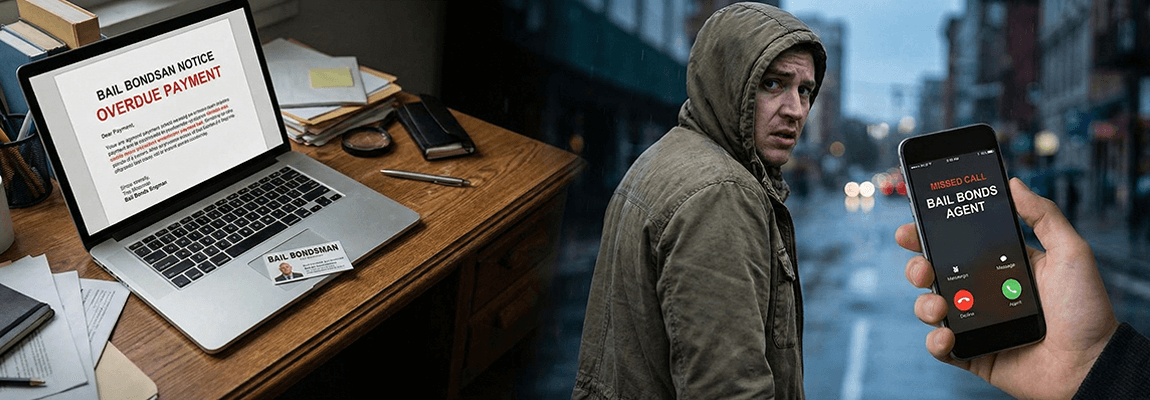

Every delinquent account on your aging report is a different problem. The co-signer on a $15,000 bond who owns a home and holds a professional job is a fundamentally different recovery situation from the unemployed family member who signed the indemnity agreement six weeks ago and hasn't returned a call since. Your collections process doesn't know that. It reaches them both the same way, on the same schedule, with the same script. That is where your recoverable revenue goes.
Most bail agency collections operations run on a flat model. A payment reminder goes out at 15 days. A call happens at 30. A notice at 45. Escalation at 60. The exact numbers vary, but the underlying logic is identical across most agencies: everyone in delinquency gets the same treatment on the same cadence, regardless of who they are, what the realistic collection window looks like, or whether the escalation cost will ever be recovered.
This creates two failure modes at the same time. High-collectability accounts get under-served on timing: you reach them on your schedule instead of when the behavioral window is actually open. Low-collectability accounts absorb staff hours and legal expenditure that will never produce a recovery. Neither failure shows up as a named line item on your P&L. Both are real and they compound across an entire portfolio. CFPB research on debt collection behavior consistently shows that first-contact timing within the first 30 days is the single strongest predictor of recovery outcome — a finding that applies directly to bail premium collections. If you want to understand where the post-execution revenue drain originates, flat collections is a significant part of the answer.
The solution isn't harder collections work. It's sorting your portfolio correctly before you start.
Key Takeaways
- Not all delinquent accounts have the same recovery path: sorting by collectability tier before starting outreach determines how much resource each account deserves and what legal options are realistic.
- The 30-to-60-day window is where most recoverable accounts can still be reached; waiting past 90 days on high-collectability accounts is the most expensive collections mistake agencies make.
- Escalation economics only make sense when matched to the tier: civil court costs roughly $1,000 to initiate in California, and spending that on an account with no attachable assets or wages produces nothing but a filing fee.
- Behavioral signals change the timeline regardless of day count: an indemnitor who clicked a payment link but didn't complete the transaction is a live lead; an account actively avoiding contact gets accelerated to the next phase.
- The agencies running this framework effectively have replaced manual cadences with systems that surface the right action for each account at the right moment, without depending on staff memory or available bandwidth.
Why the Flat Model Fails in Both Directions
The flat collections model has two distinct failure modes, and they run in opposite directions simultaneously, which is why the problem is so hard to see from inside the operation.
On the high-collectability end, the flat model is too slow and too passive. The accounts most likely to pay are most responsive to early, direct human contact. The 31-to-60-day window is where most recoverable accounts are still reachable: the delinquency is recent, the relationship isn't yet adversarial, and the indemnitor often has a practical path to paying if they are engaged correctly. A flat model that relies on automated notices through day 45 before escalating to a live call is leaving this window largely untouched on its best accounts. By the time a human reaches them at day 60 or 90, many have habituated to ignoring the notices. The most valuable collection opportunity has passed.
On the low-collectability end, the flat model is too expensive and too persistent. An account with no stable employment, no property ownership, and no history of payment compliance has limited legal recovery options regardless of how aggressively you pursue it. Spending staff hours on repeated call attempts and then filing a court action on a judgment that cannot be attached to wages or property is not collections strategy, it is sunk cost. The flat model doesn't distinguish between these accounts, so it applies the same resources to both and generates return only on one.
The most valuable collection opportunity has passed before the first live call goes out on a flat-model schedule.
A tiered framework resolves both failure modes at once. It directs early, intensive human effort toward the accounts most likely to pay and channels lower-cost automation toward accounts where the recovery probability doesn't justify the investment. The sorting work happens upfront, and everything downstream runs more efficiently as a result.
Tier by Collectability: The Primary Sort
Collectability tiering is the first axis of the framework: before any outreach strategy is determined, each delinquent account gets sorted into one of four tiers based on the indemnitor's ability to pay and the legal leverage available if they don't.
Tier 1: Homeowner with professional employment. This is the highest-collectability profile. Homeownership means real property that can be liened. Professional employment means wages that can be garnished if a judgment is obtained. Every legal recovery path is open: small claims, civil court, wage attachment, lien. These accounts justify early human engagement, accelerated escalation timelines if they go non-responsive, and civil court filings on balances where the math works.
Tier 2: Homeowner or professional employment, not both. Solid collectability with one lever for legal recovery rather than two. A homeowner without stable employment has the property exposure but limited wage attachment options. A professionally employed indemnitor without property has wage garnishment available but no asset security. These accounts warrant active outreach and structured escalation, with the available legal path factored into the escalation decision at the 90-to-120-day mark.
Tier 3: Employed but unstable. This profile presents meaningful collection challenge. Employment exists, which means some wage attachment potential in theory, but if the indemnitor changes employers frequently, the practical utility of a wage garnishment judgment shrinks considerably. Collection effort is still warranted, but timelines should run on realistic assumptions about mobility. Settlement offers and payment plan restructuring often outperform legal escalation on this tier.
Tier 4: Unemployed, disability, or no attachable income. This is the account where the fundamental constraint is not strategy, it's reality. You cannot attach wages that don't exist. Disability income is typically protected from garnishment. Without property and without attachable income, the legal escalation paths available to Tier 1 and 2 accounts are simply not available here. Continued intensive outreach on Tier 4 accounts is a resource allocation decision, not a collections decision: understand what you're spending before you spend it.
The tier assignment happens at intake for payment plan accounts and is updated when circumstance changes. An indemnitor who loses their job during the bond term moves down a tier; one who reports a new professional position moves up. The tier is not static, but it anchors every downstream collections decision in something real rather than calendar position alone. Agencies that also write retail bail with co-signer structures will recognize this framework immediately: it's the same risk logic applied to the back end of the book.
The Timing Windows: 30, 60, 90, 120
If the collectability tier is the first axis, timing is the second. The recovery window for a delinquent account is not infinite, and the decision you should be making at day 35 is categorically different from the decision you face at day 95. The framework uses four defined windows, each with a distinct operational logic.
Days 1 to 30: Automation and habit formation. Most payment delinquency in this window is administrative: a missed payment reminder, a card that expired, a co-signer who got distracted. Automated outreach handles this well. Text messages with payment links, email reminders with one-click access to the payment portal, and a light phone touch at day 15 for accounts that haven't opened the link. Human time is expensive; this window doesn't warrant much of it on most accounts. The goal is to make payment easy and maintain the habit established at bond execution.
Days 31 to 60: The highest-value engagement window. This is where the framework earns its keep. Accounts that have not paid through day 30 are showing real delinquency signals, not just administrative friction. Live outreach matters here, and it produces return that day 90 outreach simply cannot match. Tier 1 and 2 accounts get prioritized human contact in this window: a real conversation, not an automated notice. This is also where behavioral triggers become critically important. An indemnitor who clicked a payment link but did not complete the transaction is exhibiting a very specific signal: they engaged, they considered it, and something stopped them. That's a live lead, not a passive non-responder. A live agent call on a hot-moment trigger in this window converts at a meaningfully higher rate than a scheduled callback three weeks later.
Days 61 to 90: Hardening and escalation review. Accounts that have not responded through day 60 are showing avoidance patterns. The relationship has shifted. In this window, the tier matters more, not less. A Tier 1 account actively avoiding contact at day 70 gets accelerated: the avoidance behavior itself is the escalation trigger, not the calendar. A Tier 3 account going quiet at day 65 gets a different response: a settlement restructure offer and a final payment plan option before demand phase begins. The payment default signal also matters here: agencies that track bond-level behavioral data know that indemnitors going non-responsive on payment collections are showing the same avoidance pattern that precedes FTA. Both problems share a root. The collections system and the bond risk system should be talking to each other.
Days 91 to 120: The decision point. At 120 days, a demand letter goes out. That is not arbitrary: it marks the threshold where continued passive collection effort has demonstrated insufficient return and where escalation path decisions need to be made explicitly rather than by default. The demand letter is the signal to both parties that the informal resolution window has closed. What follows depends entirely on tier: civil court for Tier 1 accounts where the balance justifies filing costs, small claims for mid-range Tier 2 balances, a final settlement offer and potential external handoff for Tier 3, and a write-off or contingency agency referral for Tier 4. The decision is made with clear eyes about cost versus expected recovery rather than optimism or inertia. Agencies that systematize this decision point stop treating the 120-day mark as a failure and start treating it as a defined fork in the road with known economics on each path.
The Economics of Escalation
Every escalation path has a cost, and the path only makes sense when the expected recovery exceeds the cost of pursuing it. This is where the tier framework proves its value: it prevents you from spending civil court money on accounts where civil court can't produce a recovery.
In California, small claims court runs approximately $80 to file. Service of process adds roughly $100 per person. The statutory maximum is $5,000, and you can only file one small claims action per year. All-in, you're looking at roughly $180 to $200 to initiate, which makes small claims economically viable on Tier 1 or Tier 2 balances in the $800 and above range. Below that, the recovery rarely justifies the process even when you win.
Civil court is a different calculation entirely. Filing costs approximately $600 in California. You need an attorney signature on the pleading, which adds another $100. Service of process varies, but you are looking at roughly $1,000 all-in before the case even moves. Civil court is the appropriate tool for Tier 1 accounts with balances that justify it, professional employment or property ownership that provides attachment leverage, and a realistic path to judgment collection. Spending $1,000 to initiate a civil action against a Tier 4 account that has no attachable assets or wages produces a judgment you cannot collect. The paper says you won. The economics say otherwise.
External collection agencies operate on contingency, typically retaining 25 to 40 percent of whatever they collect. This is the last resort on accounts where internal collections have failed and the balance is insufficient to justify court filing costs. You recover a fraction, but you recover something, and you stop allocating internal resources to an account that has exceeded your internal recovery horizon.
- Small claims: ~$180 all-in, $5,000 maximum, one filing per year; viable for Tier 1 and 2 accounts at $800 and above
- Civil court: ~$1,000 to initiate in California; appropriate for Tier 1 accounts where balance and attachment leverage justify the cost
- Collection agency: contingency, 25 to 40 percent recovery; appropriate for accounts that have exhausted internal collections and where balance is below court filing thresholds
- Write-off with documentation: the economically correct decision for Tier 4 accounts where all recovery paths have costs that exceed expected return
The tier framework forces you to make this calculation explicitly rather than by feel. When the collectability tier is assigned and the balance is known, the escalation economics either work or they don't. Agencies that skip this analysis end up spending civil court money on accounts where civil court was never going to produce a return, and they record the loss as a collections failure when it was actually a process failure upstream.
Running Both Axes at Once
The power of the framework is in the intersection. Tier tells you how much an account is worth pursuing and what legal paths are available. Timing tells you where in the recovery window you are and what action the moment calls for. The combination of the two determines what you actually do.
A Tier 1 account at day 38 that has not responded to automated outreach gets a live agent call, not another text. The collectability is high, the window is open, and behavioral engagement in this window has a materially higher conversion rate than anything that follows. A Tier 4 account at day 38 gets another automated notice and a settlement discount offer: the window is the same, but the recovery ceiling is different, and the appropriate investment of human time reflects that.
A Tier 1 account at day 82 that is actively avoiding contact gets accelerated, not held on the standard timeline. Avoidance behavior is itself a trigger: the account moves to demand phase ahead of schedule because waiting until day 120 on an account that is clearly avoiding resolution loses another five weeks of the recovery window for no return. A Tier 3 account at day 82 gets a restructured payment offer and a final resolution window before demand: the goal is settlement, not judgment, because the judgment path on this tier has limited attachment options.
At day 120, every account gets an explicit escalation decision based on the tier and balance. No account drifts past this point on inertia. The demand letter goes out. The path is chosen. The resources are allocated or released. The collections module surfaces accounts at this decision point with the tier, balance, and contact history visible so the decision gets made with full information rather than a gut call on a name in a spreadsheet.
What makes this framework viable at scale is automation. Running two-axis triage manually across a portfolio of 300 active bonds with active delinquency tracking is not operationally sustainable. The agencies doing this effectively have replaced the manual cadence with a system that assigns tier at intake, tracks behavioral signals in real time, surfaces hot-moment triggers for live agent follow-up, and queues accounts for the right action at the right timing window automatically. The collections workday becomes a prioritized list rather than a memory exercise: here are the accounts that need human attention today, here is why, here is what to do.
IntelliBail's Collections module runs this two-axis framework on your full portfolio: tier-based prioritization, behavioral trigger routing, and automatic escalation queuing at the 30, 60, 90, and 120-day thresholds. No manual tracking required.
See how Collections works →