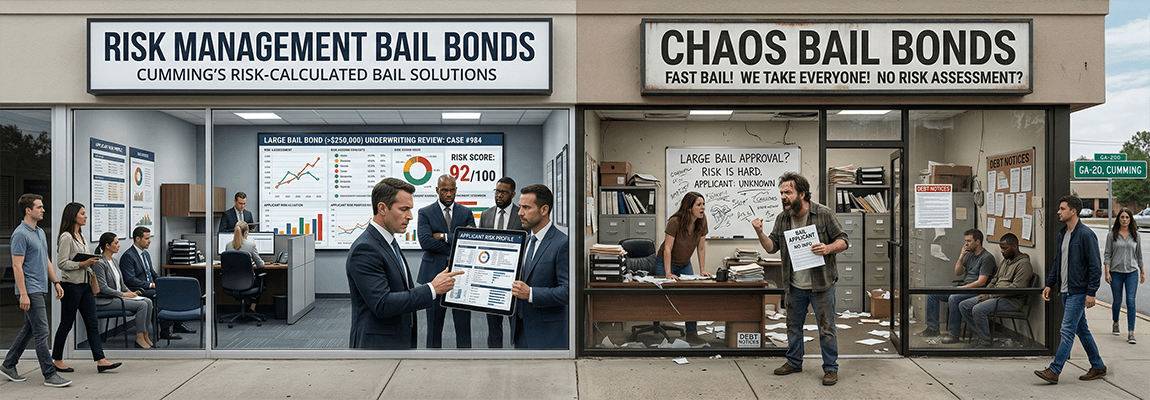
There is a moment in every bail bond office where the decision gets made. Sometimes it takes ninety seconds. Sometimes it takes twenty minutes. Rarely does it follow a formal process. The defendant is there, or their family is, or it is 2am and you are on the phone, and you make the call. You write the bond or you do not. That decision is where the financial lifecycle of a bail bond either starts with a defined risk profile or starts with a liability you will not discover for six months.
Most agencies run that decision on experience, pattern recognition, and intuition. That is not a broken model. Experienced agents do catch things. But intuition does not scale. It does not transfer to new staff. It does not produce consistent underwriting standards across a full book. The agencies running at five percent forfeiture or lower are not more intuitive than their peers. They have formalized what they know.
Key Takeaways
- Most bail bond losses are determined at signing, not at the court date: the risk variables that predict forfeiture are assessable before the bond is written, but most agencies never formally evaluate them.
- The indemnitor is the underwriting asset: a well-qualified co-signer with genuine financial exposure and real motivation to ensure the defendant's appearance is more predictive of bond success than almost any defendant characteristic.
- Four behavioral signals at intake predict forfeiture with more consistency than static application data: contact response time, collateral evasion, indemnitor engagement level, and explanation consistency.
- Systematic underwriting screens outperform gut-feel evaluation on both accuracy and consistency: agencies that formalize their intake risk assessment reduce variance and identify bonds that should be declined before they are written.
- The loss ratio is a lagging indicator of underwriting quality: the signal exists at the moment of the bond decision, not when the forfeiture filing arrives months later.
The Decision Is the Risk
The bail bond premium is collected once. The financial exposure lives for the life of the bond. That asymmetry is the foundational economics of the industry: the agency receives a fixed, non-refundable fee and assumes contingent liability for the full face amount of the bond until the defendant completes their court calendar.
Every underwriting conversation should start there. The question is not whether this defendant will probably appear. The question is what the agency's contingent exposure looks like if they do not, and what evidence exists right now that predicts which outcome is more likely.
One in ten bonds forfeits is not a randomly distributed outcome. High-risk bonds, the ones written without adequate indemnitor qualification, with inconsistent application data, or to defendants whose behavioral signals went unassessed, forfeit at multiples of the industry average. Low-risk bonds, written to well-qualified indemnitors with consistent profiles and defendants with strong compliance histories, forfeit at fractions of it. The distribution exists. Most agencies are not measuring it.
The bond decision is the leverage point. Everything that follows is management of a situation that was already set in motion at signing.
The Indemnitor Is the Asset, Not the Defendant
Most underwriting conversation in bail agencies focuses on the defendant: their charge, their criminal history, their employment, their ties to the community. These are relevant variables. They are not the primary underwriting variable.
The indemnitor is.
A co-signer who owns a home with equity, holds stable employment, and has a direct personal relationship with the defendant is a fundamentally different risk profile from a co-signer who rents, has no attachable assets, and signed because the family asked them to. The underlying charge can be identical. The outcome distribution is not.
The indemnitor provides three things that determine bond performance: financial exposure that motivates defendant compliance, a relationship channel to the defendant that the agency can use for court reminders and check-ins, and a legal obligation to assist in recovery if an FTA occurs. An indemnitor communication strategy built on genuine co-signer engagement is worth more operationally than any collection of defendant data points collected at intake.
This is the most under-weighted insight in bail underwriting. The indemnitor screen is often treated as a compliance step: get a signature, verify identity, collect collateral if applicable. The agencies with the strongest underwriting discipline treat it as the primary risk assessment. The indemnitor is not a formality. The indemnitor is the bond's recovery infrastructure, activated at the moment of an FTA. What that infrastructure looks like at signing determines what the agency has to work with six months later.
The Four Signals at Signing
Static application data tells the underwriter something about the defendant's background. Behavioral signals at intake tell them how this specific transaction is unfolding. Four behavioral signals consistently predict forfeiture with more reliability than most static variables, and all four are observable at signing without any additional data collection.
Contact response time
How quickly is the defendant reachable after initial contact? Defendants who are present, responsive, and engaged in the process are behaviorally distinct from those where the family reaches out on their behalf and the defendant is minimally involved. The disengaged defendant at intake is often the same person who does not respond to court reminders six months later. Responsiveness is a behavioral pattern, not a situational variable.
Collateral evasion
When collateral is discussed, how does the indemnitor respond? A co-signer who immediately identifies attachable assets and makes a direct commitment is communicating something about their relationship with the obligation. One who deflects, minimizes the need for collateral, or structures the conversation to avoid commitment is communicating something different: they are treating the bond as a favor rather than a financial liability they are accepting. That distinction has consequences when an FTA response requires indemnitor cooperation.
Indemnitor engagement level
Is the indemnitor present, informed, and asking questions? Or did they sign a form handed to them by the defendant's family without understanding the terms? The indemnitor who understands that they are financially responsible for the full bond amount if the defendant fails to appear is a different recovery asset than one who thinks they were doing a favor that can be undone. What an indemnitor understands about their obligation at signing is what they will act on when the agency calls at 11pm because a court date was missed.
Explanation consistency
The defendant's account of their circumstances, where they live, where they work, why they were arrested, their relationship to the indemnitor, should be internally consistent and consistent with the application data. Material inconsistencies are not always predictive of flight risk. They are always worth noting. An agent who records inconsistencies at intake has evidence to work with later, including in the fugitive recovery phase where that intake record becomes the investigation's first resource. An agent who does not has a gap in the record at exactly the moment it would be most useful.
How to Read a Defendant Profile Without Getting It Wrong
Risk assessment in bail runs on both quantitative and qualitative variables, and the interaction between them is where experience matters most. The mistake is applying either dimension in isolation.
Charge type and severity are relevant but frequently overweighted. A high-severity charge does not automatically produce a high-risk bond. A defendant with deep community ties, stable employment, a strong indemnitor, and a history of consistent court appearances may represent lower forfeiture risk on a serious charge than a defendant with minor prior charges and none of those stabilizing factors. The charge is what the court set bail on. The risk profile is what the agency is underwriting.
Flight risk variables with consistent predictive power include: prior failure to appear history, which is the most reliable single variable available at intake; recent residential instability; pending charges in other jurisdictions; and employment instability at a level that makes premium payment plan default probable. Premium delinquency and FTA risk are correlated. A defendant whose indemnitor is already struggling with the first payment is a defendant whose compliance infrastructure is already stressed before the first court date arrives.
Context matters for every factor. A single prior FTA from ten years ago for a defendant who has since maintained consistent employment and family ties is a different signal than three prior FTAs in the last four years. Reading the profile means reading the whole profile, not applying a single-variable threshold and treating the decision as made.
The Underwriting Variables That Actually Predict Forfeiture
The variables with the strongest predictive relationship to forfeiture cluster around three domains, synthesized from agency operations experience, pretrial compliance research, and surety loss data across high-volume bail markets.
Compliance history. Prior FTAs are the single most reliable predictor of future FTAs. The recency and context of prior FTAs matters as much as the count, and an agency that writes bonds for defendants with prior FTAs without weighting recency is using incomplete information. A defendant with two prior FTAs in the last eighteen months who has not resolved those cases is a materially different risk than one with a single FTA from several years ago that was resolved without issue.
Stability indicators. Residential tenure, employment duration, and family relationship depth are associated with lower forfeiture risk across virtually all pretrial compliance research. Defendants with several years at the same address, consistent verifiable employment, and meaningful family relationships in the jurisdiction forfeit at substantially lower rates than defendants who moved recently, have no verifiable employment, and whose family relationships are strained. These factors are assessable at intake. They are not always asked about systematically.
Indemnitor quality. As discussed: the co-signer's financial exposure, their relationship depth with the defendant, and their demonstrated engagement with the obligation are the most controllable variables in the underwriting process. They can be screened. Most agencies do not screen them formally, which means the most controllable variable in the risk assessment is also the most frequently unexamined.
This is where the FTA prevention framework connects directly to the underwriting decision: the agencies that consistently prevent failures to appear are often the same agencies doing the most rigorous underwriting, because they have already identified and declined the highest-risk bonds before they become managed recoveries. The summary judgment proceedings that agencies most want to avoid are frequently the downstream output of underwriting decisions that did not adequately account for these variables at signing.
From Gut Feel to Systematic Screen
The problem with gut-feel underwriting is not that experienced agents get it wrong. It is that the knowledge is locked in individual agents, it does not scale across staff additions, it does not produce consistent decisions during high-volume periods, and it cannot be audited when outcomes are bad.
A systematic underwriting screen does not replace judgment. It structures and captures it.
The practical components are simpler than they sound: a defined set of intake questions asked on every bond regardless of relationship or apparent risk; a scoring or flagging mechanism that assigns relative weight to the key variables, particularly prior FTA history, indemnitor qualification, and stability indicators; a collateral threshold tied to risk assessment rather than bond amount alone; and a declination process that documents why a bond was not written.
That last item is the most undervalued. The agencies that track declined bonds and monitor what percentage of those would have forfeited have a feedback loop that improves underwriting over time. Agencies that decline on intuition and never record it have no mechanism to learn from the decision, and no way to demonstrate to the surety that they are operating with a consistent underwriting standard when a loss ratio conversation becomes necessary.
IntelliBail's structured intake protocol is designed around this model: consistent data collection across all bonds, variable weighting for risk assessment, and a documented decision trail that holds up under surety review and improves in accuracy over time as the agency's own data accumulates.
What Your Loss Ratio Is Actually Telling You
The loss ratio is a lagging indicator. By the time it appears in the P&L or surfaces in a conversation with the surety, the decisions that produced it were made months ago. That is the fundamental timing problem in bail agency underwriting: cause and effect are separated by six months to two years, depending on the bond term and the forfeiture timeline. The agent who wrote the problematic bond in March may not connect it to the summary judgment conversation happening in October.
Your current loss ratio is a signal from past underwriting decisions. If it is trending up, the question to ask is not what is happening now. The question is what decisions were being made six to eighteen months ago, and what was different about the bonds currently in forfeiture compared to the ones that exonerated cleanly. The answer to that question lives in the intake records, if they exist in sufficient detail to answer it.
The post-execution revenue drain compounds on a weak underwriting decision. A bond written to a thin indemnitor on a marginal profile does not just risk forfeiture. It is more likely to produce premium payment delinquency, require more intensive monitoring and intervention, and generate more staff time per premium dollar collected than a well-underwritten bond. Every variable that predicts forfeiture also predicts post-execution operational cost. They are the same risk, expressed at different points in the bond's timeline.
Underwriting quality is not just a forfeiture prevention strategy. It is a margin protection strategy. The agencies that write tighter books spend less managing the bonds they write, collect more of the premium they quote, and surface their exoneration documentation to the surety on a clean, documented timeline. The lowest-cost bond to manage is a well-underwritten bond. That is not an insight that appears in the loss ratio until the evidence of it has already accumulated.
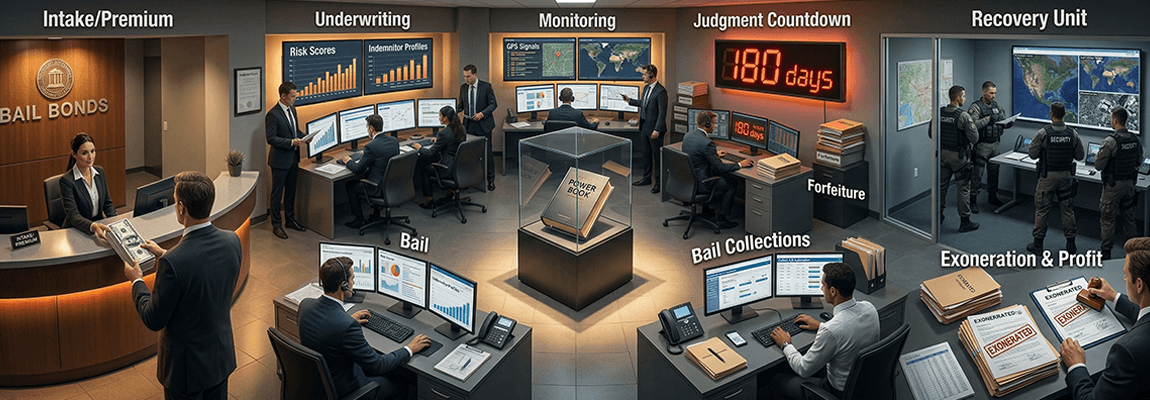
The underwriting decision is the first phase in the bond's financial arc. The financial lifecycle of a bail bond maps every phase from the bond decision through collections, and shows how the risk profile established at signing propagates through every downstream event: post-release compliance, FTA response, recovery timelines, and the indemnitor collections conversation that comes at the end. The agencies that get the underwriting right are not just preventing forfeitures. They are setting the conditions for a cleaner, lower-cost, more profitable book at every phase that follows.
The discipline to formalize what experienced agents already know is not a complicated operational change. It is a documentation and consistency problem. The agencies that have solved it are not writing less business. They are writing better business, and the difference shows up everywhere the loss ratio cannot see until it is already too late.
IntelliBail's Risk module is built for this: structured intake protocols, consistent risk scoring across every bond in the book, and a documented underwriting trail that improves over time and holds up under surety review.
See how IntelliBail structures intake →