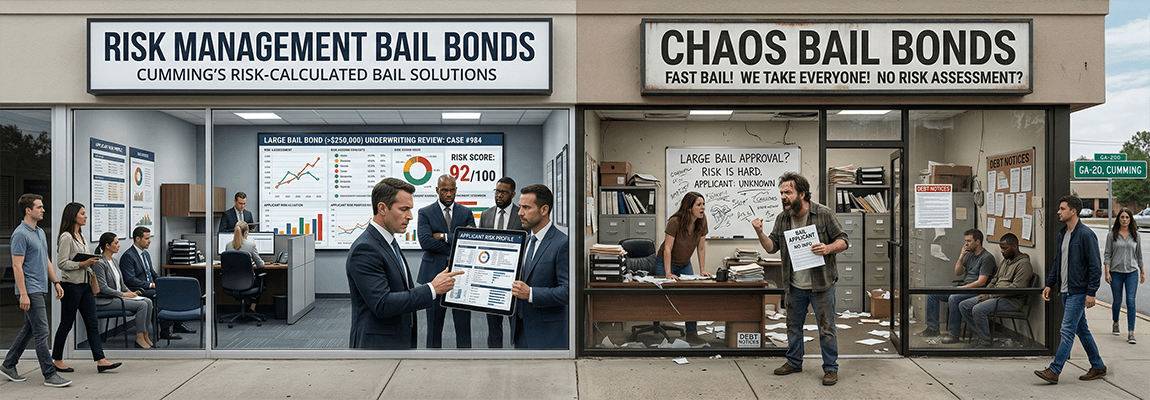

The underwriting decision in bail is usually framed as the moment when an agent reviews the bond amount, checks the charge, and decides whether to write. That framing is too late. The information that determines whether a bond is a good risk is almost entirely available in the intake call, before any documentation is requested and before any formal review begins. The agents who collect that information systematically make better underwriting decisions. The agents who treat intake as a data entry exercise make decisions with half the picture.
This is not an argument for longer intake calls. It is an argument for differently structured ones. The same conversation that most agencies use to collect a name, a charge, and a bond amount can be used to surface the risk signals that determine whether that bond belongs in the agency's book. The information is available in the first five minutes. The question is whether the agency is asking for it.
Key Takeaways
- The intake call is not administrative; it is the last moment in the process where the agency controls what risk it takes on before the bond is executed, and most agencies underuse it as a risk management tool.
- Most agencies collect enough information to write the bond; low-loss agencies collect enough information to evaluate whether they should.
- Defendant history, employment status, geographic stability, hearing proximity, and indemnitor relationship strength are all signals available at intake; agencies that do not systematically capture them are making underwriting decisions with less information than the risk warrants.
- Indemnitor qualification is not a separate step from intake; it is an integrated part of the same conversation, and agencies that defer it frequently discover indemnitors who cannot or will not fulfill the obligation.
- An intake protocol that functions as a risk screen does not require more time than a standard intake call; it requires a different structure for the same conversation.
Why Intake Is Underwriting
The formal underwriting review that happens in most bail agencies, the review of court records, criminal history, and charge severity, is a verification step. It confirms information and catches discrepancies. It does not generate new risk intelligence. The risk intelligence that shapes the underwriting decision is almost always available earlier, in the first conversation with the person calling to post bail, before the review begins.
Most bail bond losses are not written into the bond at the formal review stage. They are written in at intake, when the agent collected enough information to write the bond but not enough to evaluate whether the risk was acceptable. The underwriting risk assessment framework that separates low-forfeiture agencies from the rest begins at the intake call, not at the desk review.
Consider what the intake caller already knows and is willing to share: their relationship to the defendant, where the defendant lives and works, the defendant's prior court history (from their own knowledge, not a database), whether the defendant has prior failures to appear, and whether the household can actually sustain the financial and logistical obligation of monitoring a defendant through what may be a multi-hearing case. None of this requires a records search. All of it is available in conversation if the agent is structured in how they gather it.
The financial lifecycle of a bail bond is defined at execution. The decisions made at the intake call are the first and most controllable inputs into that lifecycle. Agencies that treat intake as the start of the underwriting process consistently make better decisions at execution than agencies that treat it as a prelude to the paperwork.
The Information Gap
The information most agencies collect at intake covers what is required to write the bond: defendant name, date of birth, booking number, charge, bond amount, and indemnitor contact information. That is the minimum viable dataset for execution. It is not a dataset from which meaningful risk assessment is possible.
The information that makes risk assessment possible includes: defendant's current employment status and employer, defendant's length of residence at current address, defendant's prior criminal history and specifically any prior FTAs, the nature of the relationship between the caller and the defendant, whether the caller has personal knowledge of the defendant's current circumstances, the proximity of the first scheduled court date, and the indemnitor's financial and logistical capacity to fulfill their obligation if the defendant becomes non-compliant.
The gap between these two datasets is where most underwriting errors originate. An agency that writes a $50,000 bond for a defendant who has been living in the jurisdiction for three months, has no stable employment, and is represented by a caller who does not actually know them well has taken on a risk profile that looks acceptable at the execution stage but was already visible at intake to anyone asking the right questions.
The Bureau of Justice Statistics research on pretrial compliance consistently identifies residential stability, employment, and community ties as the primary predictors of appearance compliance. These are not abstract risk factors. They are questions that can be asked in the first five minutes of an intake call if the agency has built a protocol that asks them.
Defendant Signals That Matter at Intake
Several defendant-level signals are reliably available through the intake caller and reliably predictive of FTA risk. Not all callers will provide accurate information on all of them, but the pattern of answers, including evasions and contradictions, is itself informative.
Prior FTA history is the most predictive single signal. A defendant with a prior failure to appear is statistically more likely to fail again, and this history is often known to the person calling to post bail even before any records search. An agent who asks directly whether the defendant has ever missed a court date before gets an answer that is either confirmatory, contradicted by records, or evasive, all of which are useful data points.
Geographic mobility is the second signal. A defendant who has lived at the same address for two or more years is a materially different risk profile than one who has moved multiple times in the last year or who is staying with rotating contacts. A defendant who has moved to the jurisdiction recently from another state for reasons the caller cannot explain is a different profile still. These are all available from conversation before any database lookup.
Hearing proximity is a third signal that most agencies do not weight appropriately at intake. A defendant with a court date in four days is a structurally different risk than one with a court date in six weeks. The shorter the window to first appearance, the higher the urgency, and urgency itself is a risk variable: defendants who are rushed to post bail before a close hearing date have less time for the social and logistical grounding that supports compliance. The FTA prevention framework accounts for this, but the signal needs to be captured at intake to be actionable.
Indemnitor Qualification at the Point of Contact
The indemnitor is not a secondary figure in the underwriting equation. They are the accountability mechanism that keeps a defendant compliant with court obligations for the duration of the bond. An indemnitor who is weakly connected to the defendant, financially overextended, or uncertain about their willingness to fulfill the obligation is not a reliable accountability mechanism, regardless of what the signature on the agreement says.
Indemnitor qualification at intake requires asking three categories of questions: relationship, capacity, and commitment. Relationship: how well does the indemnitor know the defendant, how frequently do they have contact, and will the defendant live in proximity to them during the case? Capacity: does the indemnitor have the financial resources to absorb the premium payment structure without delinquency, and do they have the logistical capacity to monitor the defendant's compliance? Commitment: do they understand what they are agreeing to, do they understand that they are liable for the full bond amount if the defendant fails to appear, and do they believe the defendant will comply?
That last question is the one most agents do not ask directly, and it is one of the most informative. An indemnitor who expresses confidence in the defendant's compliance and understands the obligation is a fundamentally different profile than one who is posting bail out of family obligation, expresses anxiety about the defendant's reliability, or cannot clearly articulate what they are agreeing to. The indemnitor relationship that supports recovery after an FTA begins with the quality of this initial contact, not with outreach that starts only after something goes wrong.
Premium payment capacity is also part of indemnitor qualification, not just a collections input. An indemnitor who is financially stressed at the point of posting bail will likely be delinquent on an installment plan within 60 days. The premium financing structures that work operationally are built on indemnitor qualification at intake, not discovered to be problematic at the second missed payment.
The Intake-to-Underwriting Handoff
The intake call and the formal underwriting review are separate processes in most agencies. They should be, because they serve different functions: one is a conversation, one is a records-based verification. The problem is that the output of the intake call, in most agencies, is a data entry record with just enough information to initiate the review, not a risk profile that the underwriting review is designed to confirm or challenge.
Agencies that use intake as a risk management tool structure the handoff differently. The intake record that moves to underwriting includes not just the execution-required fields, but a structured risk profile: defendant stability signals, prior FTA flag, indemnitor qualification notes, and any anomalies or contradictions observed during the intake conversation. The underwriting review then operates in relationship to that profile, either confirming it against records or elevating the scrutiny when the profile raises questions.
This changes the nature of the underwriting decision. Instead of reviewing records to decide whether to write, the underwriter is reviewing records to confirm or challenge an already-developed risk assessment. Flags that might be missed in a records-only review are visible because the intake call already surfaced them. The decision is better informed, and the decision-making process is faster because the relevant risk signals have already been organized.
Building an Intake Protocol That Functions as a Risk Screen
An intake protocol that functions as a risk screen requires three components: a structured question sequence that covers the key risk signals, a documentation format that captures qualitative observations alongside required fields, and training that frames the intake call as the start of underwriting rather than the start of paperwork.
The question sequence does not need to be lengthy. Five to seven questions beyond the required execution fields, asked in a natural conversational flow, are sufficient to cover the major risk dimensions: employment and residential stability, prior FTA history, indemnitor relationship and commitment, hearing proximity, and any concerns the caller expresses about the defendant's situation. The questions should be open-ended enough to surface concerns the caller may not volunteer and specific enough to generate actionable data points.
The documentation format should include a field for agent observations, not just structured data fields. The observation that "caller was evasive when asked about prior court history" or "indemnitor expressed uncertainty about defendant's reliability" is risk information. It does not fit in a dropdown menu. It belongs in a notes field that the underwriting review reads before making a decision.
The operational infrastructure that makes systematic intake qualification possible is the same infrastructure that drives performance across the full book. The Insight module structures the intake and underwriting workflow around risk signal capture rather than execution documentation, which means that the information gathered in the first conversation is organized where it can inform the decision, rather than buried in a record that underwriting never reads. The data on why bonds forfeit is clear: the agencies running at the lowest forfeiture rates are not writing fewer bonds. They are writing fewer bad ones, because they identified the bad ones before they signed.
The intake call and the underwriting decision should be part of the same process. The Insight module structures the intake workflow around risk signal capture, surfaces defendant and indemnitor profiles in real time, and connects the information gathered in the first call to the underwriting review that follows. The information already exists in the conversation. The question is whether your system captures it where it matters.
See how Insight works →