
When a defendant misses a court date, the bail agency's relationship with the bond changes immediately. What was a monitoring obligation becomes a recovery obligation. What was a latent financial exposure becomes a live clock. The forfeiture notice has been filed. The appearance period has begun. The financial lifecycle of a bail bond has just entered its most operationally intensive phase, and the decisions made in the first 72 hours will determine whether the agency recovers its position or starts planning how to absorb the loss.
Most agencies understand that they have a window. Fewer have a structured plan for what happens inside it. The result is a pattern that shows up in every high-forfeiture book: early days lost to hoping the defendant self-reports, middle weeks lost to unfocused follow-up, and final weeks spent scrambling toward a deadline that has been visible since day one.
Key Takeaways
- The first 30 days after an FTA determine outcome in the vast majority of cases: defendants located within this window are recovered at rates multiples higher than those where initial investigation is delayed or unfocused.
- Recovery is an information campaign, not a manhunt: the agencies that find defendants fastest work from a structured investigation model, prioritizing indemnitor intelligence, digital footprint analysis, and relationship network mapping before physical pursuit.
- The indemnitor is the most valuable recovery asset: a co-signer who was properly engaged at intake and maintained through the bond term has information, contacts, and motivation that no recovery professional can replicate from outside the relationship.
- Recovery vendor relationships are a strategic resource, not an emergency call: agencies with established networks of recovery professionals and skip tracers consistently produce better outcomes than those assembling resources after an FTA occurs.
- The recovery outcome is largely determined before the FTA happens: the quality of intake documentation, indemnitor relationship maintenance, and established vendor networks at the moment of FTA determines what the agency has to work with inside the window.
The Clock and the Window
A bail bond forfeiture is not the end of the relationship. It is the beginning of the recovery phase. The forfeiture converts the bond from an active surety obligation to a contingent liability with a court-mandated resolution window: typically 180 days from the date of forfeiture before summary judgment can be entered against the surety. That window looks generous from the outside. It is not.
Subtract the first week of administrative response, the initial investigation period, and the final 30 days needed for legal evaluation if a reinstatement motion becomes necessary, and the effective working window for physical recovery is considerably shorter than six months. The agencies that consistently produce defendants within the statutory period are not operating more aggressively in the final weeks. They are operating more systematically in the first ones.
One in ten bonds forfeits. What happens after the forfeiture is what separates the agencies that manage their exposure from the ones their exposure manages.
What the First 72 Hours Actually Determine
Recovery outcome correlates more strongly with what happens in the first 72 hours after an FTA than at any other point in the appearance period. The reasons are structural, and understanding them explains why early action is not just better practice but a categorically different operational posture.
At 72 hours, information is still warm. The defendant was in contact with the indemnitor recently. Their daily patterns have not yet changed to account for being actively sought. They may still be reachable through normal channels. A phone call to the right contact in the first 48 hours can produce a cooperative surrender. That same call 30 days later reaches a number that has been changed or goes to a family member who has been told not to cooperate.
By day 30, the picture has cooled significantly. Defendants who are aware they are being sought have altered their behavior. Indemnitors may have been coached to be evasive. The probability of a fast, cooperative resolution, which is the lowest-cost outcome available, declines with each week of inaction. The agencies with the best recovery rates activate a structured first-response protocol at the time of FTA, not when they realize they are running out of time.
The FTA prevention framework built from day one of the bond is what makes this early-response protocol functional. The information gathered at intake and through the bond term is the first information the recovery protocol uses. An agency that enters a recovery situation with a complete intake record, warm indemnitor contacts, and documented behavioral history from the bond term starts from a position of knowledge. An agency that enters with a thin file and a cold indemnitor starts from zero.
Recovery Is Intelligence, Not Force
The image of fugitive recovery most people carry, a physical search, surveillance, and apprehension, is the end of a process that begins with an information campaign. The agencies that recover defendants fastest understand this distinction. The ones that go straight to physical search spend the most on recovery and often produce the worst results, because they are looking in the wrong places based on assumptions rather than evidence.
The information campaign follows a predictable structure.
Inventory what is already known. The first phase is an organized review of existing information: last known address, employment status, vehicle, known social contacts, digital identifiers, and the indemnitor's most recent communication with the defendant. A well-documented intake record, built at signing and updated through the bond term, is a recovery asset. A thin intake record is an investigation that has to start from scratch, at the worst possible moment.
Identify who knows more. The second phase is a systematic contact sweep: the indemnitor first, then extended family if reachable, then employers, community contacts, and anyone else identified at intake. The goal is not confrontation. It is information. The tone of these early contacts determines whether the agency gets cooperation or silence, and that distinction can compress or eliminate the physical search phase entirely.
Follow the trail. The third phase incorporates digital investigation: social media activity, public records, vehicle registrations, and known associates whose public posts may reveal location-identifying information. These are open-source intelligence reviews, not surveillance operations. Executed systematically, they produce actionable leads at a fraction of the cost of physical field work deployed without direction.
Physical location and apprehension follow information. Compressing or skipping the information phase does not save time. It multiplies the time and cost of the physical phase by removing the direction that good information provides: those compounded recovery costs are a direct component of the post-execution revenue drain that separates profitable books from unprofitable ones.
The Indemnitor as a Recovery Asset
The indemnitor is the agency's most underutilized recovery resource. Most agencies treat them as a financial backstop. The agencies with the best recovery outcomes treat them as the primary investigation asset.
A co-signer with a genuine relationship with the defendant has something no recovery professional can replicate from outside: direct access to the defendant's social network, current relationship status with family members, and personal history that creates context for understanding current behavior. They also have financial motivation. The co-signer who signed the bond is legally and financially exposed if the agency cannot produce the defendant within the window. That exposure, properly communicated and properly managed, is a powerful motivator for cooperation that no external resource can generate.
An indemnitor communication strategy maintained through the bond term is what makes this work. The indemnitor who has had regular, professional contact with the agency through the bond period is reachable, has current contact information on file, and is in an established professional relationship that makes cooperation natural when the call comes. The indemnitor who was contacted once at signing and then ignored for months may not be reachable, almost certainly has aging contact information, and may not understand their legal obligation clearly enough to respond constructively when the situation requires it.
The quality of the indemnitor relationship at the time of an FTA is a direct output of indemnitor engagement during the bond term. This is one of the most direct operational lines in bail between proactive management and recovery outcome.
Digital Footprints and Modern Location Work
Open-source digital investigation has changed the practical mechanics of fugitive location significantly over the last decade. Most defendants who are not actively concealing themselves leave accessible digital trails, and structured investigation methodology has become as important as field capability for agencies that recover consistently well.
Social media accounts, either the defendant's own or those of close contacts who post location-identifying content, are consistently the most productive initial source. Geographic tags, event check-ins, and photos with identifiable backgrounds can narrow location to a specific area without any physical deployment. Defendants and their networks are often unaware of how much information is publicly accessible through social media that appears private or casual.
Public records provide the documentary layer: vehicle registration in the defendant's name or known associates, utility accounts, court records in adjacent jurisdictions (including federal case filings through PACER) that may indicate recent presence, and professional license databases that can confirm current employment. These records are accessible, often free, and systematically reviewed by agencies with a structured operational workflow. They are rarely reviewed by agencies operating reactively.
Skip tracing services bridge between open-source investigation and professional field work. Used selectively, for defendants where internal investigation has produced insufficient direction, they deploy specialized data access and proprietary information sources that extend the agency's reach efficiently. The agencies with established skip trace relationships deploy this resource at the right point in the investigation sequence, not as a first response that bypasses information collection or as a last resort that arrives when the window has already narrowed dangerously.
When to Involve a Recovery Professional
Professional recovery agents, bail enforcement agents and field investigators, are most effective when deployed with good information and a clear task. They are least effective when deployed as a substitute for investigation that should have happened internally, or when activated so late in the window that the situation is already past salvage.
The decision threshold for professional involvement should be defined in advance, not determined case-by-case under pressure. A reasonable framework: when internal investigation and indemnitor outreach have failed to produce a cooperative resolution within 30 to 45 days, and when the remaining window is sufficient for a professional engagement to be productive, the escalation to field recovery is appropriate. Deploying professional recovery at week four of a 26-week window leaves time for a thorough investigation and multiple recovery attempts. Deploying it at week 22 is a last-ditch effort on a timeline that no longer accommodates the process.
The relationship with professional recovery vendors should be built before it is needed. Vendors who know the agency, understand its documentation standards, and have worked cases before are faster, more effective, and more communicative than cold relationships assembled at the point of a specific crisis. The agencies with the best vendor networks treat those relationships the same way they treat their surety relationship: as a strategic asset maintained proactively, not a transactional resource activated in emergencies.
The Decision That Determines Whether You Win
The most consequential variable in fugitive recovery is not how aggressively the agency pursues the defendant after an FTA. It is the condition of the agency's information, relationships, and protocols at the moment the FTA occurs.
An agency that has maintained a complete intake record, sustained an active indemnitor relationship through the bond term, documented behavioral signals and contact history, and built established vendor relationships enters the recovery phase with a defined playbook and warm contacts. The investigation begins from a position of knowledge, not urgency trying to reconstruct a relationship that was never built.
The underwriting decisions that went into writing the bond also matter here. A well-underwritten bond, written to a qualified indemnitor with genuine financial exposure and a real relationship with the defendant, produces a fundamentally different recovery environment than a bond written to a nominal co-signer with limited assets and minimal connection to the defendant. The underwriting decision is the first link in the recovery chain. The indemnitor quality at intake determines the indemnitor quality when the agency needs them most.
The recovery window is 180 days. The recovery outcome is largely determined in the first 30. The operational infrastructure that makes those 30 days productive is not assembled after the FTA. It is built from the moment the bond is written, through every phase of management that follows, and it is available, or not, at exactly the moment it is needed.
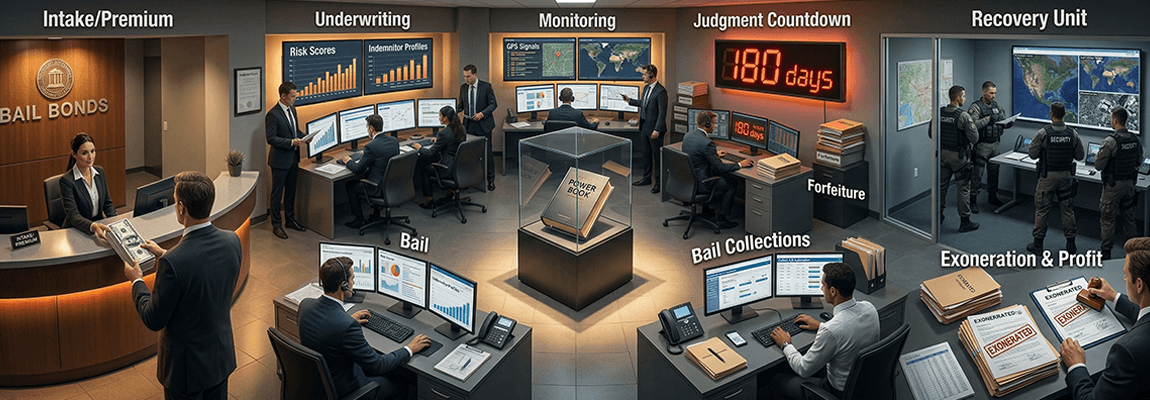
The recovery phase is one of seven distinct phases in the bond's financial arc. The financial lifecycle of a bail bond maps how each phase, from the underwriting decision through collections, connects to the next, and shows why operational discipline at the recovery phase protects the agency's position across everything that follows.
The agencies that find defendants consistently are not the ones with the most aggressive recovery posture. They are the ones that have made recovery a planned operational capacity rather than a reactive event. That is a decision made long before the FTA notice arrives.
IntelliBail's Recover module is built for this: structured FTA response protocols, indemnitor contact sequencing, deadline tracking across every active forfeiture, and the operational visibility that makes the first 30 days the agency's most productive recovery window.
See how Recover works →