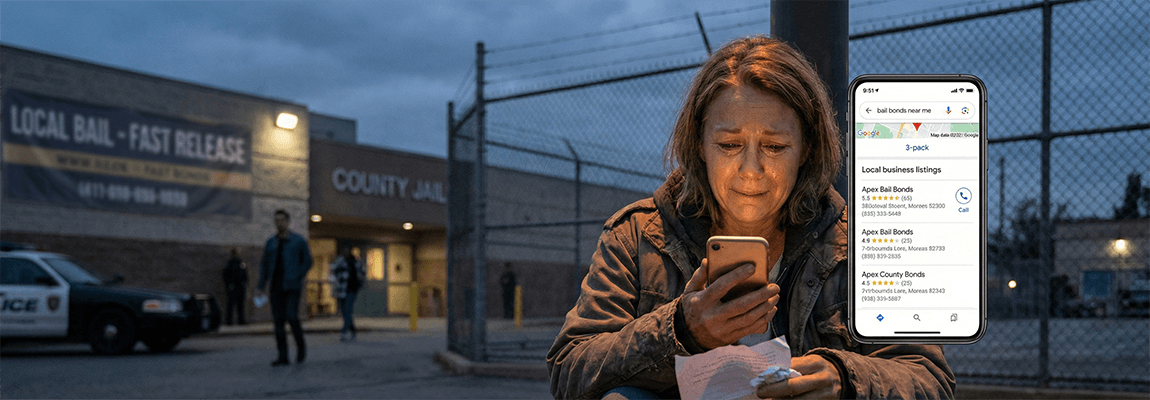
A family gets the call at 11 PM. Someone they love is in a county jail across town and they need a bondsman now. They pull out a phone, type a search, and look at the first three results Google shows them. That is your competition. Not your website alone, not your years in the business, not your reputation with the courthouse. The first three results. That is the entire game.
For most local service businesses, organic search is one channel among several. Bail bond agencies do not have that luxury. In 2018, Google and Facebook both banned for-profit bail bond advertising, and the ban has remained in place for over seven years with no indication of reversal. The paid channel is closed. That structural reality makes local SEO not a marketing tactic but the primary acquisition infrastructure for every agency in the country, and most are competing at a serious disadvantage.
Key Takeaways
- Google and Facebook both banned for-profit bail bond advertising in 2018, making organic local SEO the primary and often only acquisition channel for the industry.
- The Google Business Profile primary category selection accounts for approximately 60 to 70 percent of local pack ranking weight, making it the single highest-leverage configuration change most agencies have never made correctly.
- Review recency outranks review volume in Google's local algorithm; an agency with 25 reviews from the past 90 days will consistently outrank a competitor with 100 reviews that are 18 months old.
- County jail landing pages, one for each detention facility served, are the most underused on-page tactic in bail bond SEO because jail-specific searches carry the highest search intent of any query in the category.
- 84 percent of bail bond searches happen on mobile, and a 100-millisecond increase in page load time reduces conversion rates by approximately 7 percent, making page speed a direct driver of inbound call volume.
- Click-to-call phone buttons convert at 10 to 12 times the rate of contact forms on mobile devices, which means any bail bond website that leads with a form over a phone number is structurally losing calls every day.
The Paid Channel Is Gone and That Changes Everything
Most industries have a paid search option. A law firm that wants more cases can run Google Ads. A plumber can run Local Service Ads. A car dealership can run display campaigns across every platform available. Bail bond agencies cannot do any of that. The 2018 bans removed the paid channel entirely, and because bail bond rates are state-regulated in most jurisdictions, agencies cannot compete on price either. The only levers left are visibility and reputation, and visibility is almost entirely a local SEO problem.
The search behavior of bail bond clients is unlike almost any other local service. The intent is immediate, the emotional state is acute, and the decision cycle is compressed to minutes. Research from BrightLocal shows that 44 percent of all local search clicks go to the Google 3-pack, the three businesses Google surfaces before any organic results appear. Businesses that appear in the 3-pack receive 93 percent more direct actions, which in this context means calls, than those that appear only in organic results below it. The family searching at 11 PM is calling one of those three businesses. The fourth result is invisible.
84 percent of bail bond searches happen on mobile devices. That number is higher than almost any other local service category because the search is happening in real time: someone just received a call from a jail, they are standing in a parking lot or sitting in a car, and they are making a decision in under two minutes. This is not a considered purchase. It is a crisis response. The agency that shows up first and loads fastest gets the call. Reputation matters enormously for retention and referrals, but you cannot build a reputation with a customer you never reached in the first search.
The competitive implication of the paid ban is significant: local SEO mastery in this category creates a defensible position. An agency with strong local search visibility cannot be outbid by a competitor with a larger budget. The work is structural and compounds over time in a way that paid advertising cannot replicate.
Your Google Business Profile Is the Highest-Leverage Asset You Are Not Optimizing
Google's local pack ranking algorithm weighs three primary signals: proximity, relevance, and prominence. Your website primarily influences relevance and prominence over time. Your Google Business Profile influences all three, and it influences them faster. Most bail bond agencies have a GBP. Most of them are significantly under-optimized in ways that directly suppress local pack visibility.
Primary category selection is where most agencies lose first. The primary category you assign to your GBP accounts for approximately 60 to 70 percent of your local ranking weight for category-relevant queries. "Bail bondsman" is the correct primary category for most agencies, but many profiles are filed under "Bail bond agency," "Legal services," or generic alternatives that carry lower signal strength for the specific queries bail clients use. Verify your primary category first. It is a five-second change that moves the needle more than almost anything else in the optimization checklist.
Photos are a ranking signal with a dramatic ROI. Google profiles with more than 100 photos generate 520 percent more calls than those with fewer than 10. Most bail agencies upload a logo, maybe a photo of the office exterior, and stop there. The profiles that dominate the local pack in competitive markets often have 50 to 150+ images: interior shots, signage, staff photos without identifying individuals if preferred, exterior from multiple angles, and county maps if you serve multiple jurisdictions. Photos signal an active, legitimate business to both Google's algorithm and the prospective client deciding whether to call.
Hours matter more than most agencies realize. If your agency operates 24 hours a day, seven days a week, that needs to be configured in your GBP correctly. Searches spike during evening hours and weekends when courts are closed and defendant processing is active. An agency whose GBP shows hours ending at 6 PM loses ranking visibility for those high-intent late-night queries, even if the phone is physically answered around the clock. Configure your hours as 24/7 and use the "more hours" feature to reinforce it.
The Q&A section is free content that most profiles leave empty. Google allows anyone to submit questions to a business profile, and the answers become public. Most agencies ignore this section entirely. Fill it yourself: "What counties do you serve?", "Do you offer payment plans?", "How long does it take to get someone released?" These are exactly the questions families are asking, and populating the answers controls the narrative before a competitor or a frustrated former client does.
GBP posts keep the profile algorithmically alive. Google treats profile activity as a freshness signal. Publishing a post once a week, even a brief service area update or a question-and-answer style post, signals consistent engagement to the ranking algorithm. The content does not need to be elaborate. The activity does.
The On-Page Work That Compounds Over Time
A well-optimized GBP will get you into contention for the local pack. The on-page work on your website is what sustains and extends that position, particularly for the organic results beneath the pack and for the longer-tail queries that the pack alone does not capture.
NAP consistency is non-negotiable. NAP stands for Name, Address, and Phone, and it needs to be identical across every place your business appears online: your website, your GBP, every directory listing, every citation. A single inconsistency, a different phone format on Yelp than on your website, a suite number on one directory that is absent from another, is interpreted by Google as a trust signal problem. Research from local SEO aggregators shows that consistent NAP across citations corresponds to approximately a 16 percent improvement in local pack appearance rate. Audit every major directory: Google, Bing, Yelp, Apple Maps, Facebook, YellowPages, BBB, and the bail-specific directories that carry domain authority in the category.
County jail landing pages are the most underused tactic in the category. A single homepage targeting "[your city] bail bonds" is competing against every other agency in the metro. A page targeting "[County Name] Detention Center bail bonds" or "[Specific Jail] bail bondsman" is competing against a much smaller pool for a query with extremely high commercial intent. The family searching for "bail bonds [Specific Jail Name]" knows exactly where their loved one is being held and is ready to call the first credible result. Build a dedicated page for every county jail and detention facility your agency serves. Each page should include the facility name, address, intake hours, bond process for that specific facility, and your contact information. These pages rank for long-tail queries that most competitors do not even have pages for.
LocalBusiness schema with correct hours is a technical differentiator. Schema markup tells Google what your business is, where it is, and when it operates in a machine-readable format that improves how your listing appears in search results. For bail bond agencies, the critical elements are: business name, address, phone number, category, and openingHoursSpecification set to 24/7 if that is accurate. Most bail agency websites have no schema at all. Implementing it correctly takes two to four hours and produces a lasting technical advantage. Agencies running on a modern platform can often deploy schema site-wide without touching individual pages.
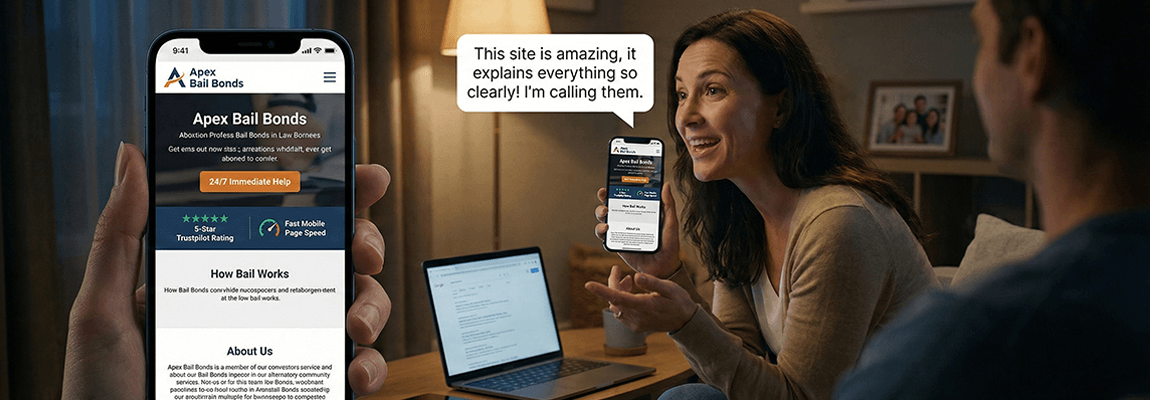
Page speed is the hidden conversion variable. 84 percent of bail bond searches are on mobile, on a cellular connection, at an emotionally heightened moment. A page that takes five seconds to load loses that caller. Google's mobile page speed research shows that a 100-millisecond increase in page load time reduces conversion rates by approximately 7 percent. That is not a rounding error for a business where a single inbound call can represent thousands of dollars in premium. Target a Largest Contentful Paint under 2.5 seconds. Compress images, eliminate render-blocking resources, and host on a CDN if you are not already. The agencies operating the most efficiently treat their digital infrastructure the same way they treat their intake workflow: slow means lost.
The phone number should be the first thing visible on every page. Click-to-call phone buttons convert at 10 to 12 times the rate of contact forms on mobile devices. This is not a preference; it is a documented behavioral reality of high-intent mobile searches. Any bail bond website that surfaces a contact form before a phone number is structurally losing calls to the next result that makes the call frictionless. The phone number should be in the header, sticky on mobile, and tappable on the first screenful of every page.
Review Velocity Is the Moat No Competitor Can Buy
Google's local ranking algorithm places significant weight on reviews, but not in the way most agencies assume. Volume matters, but recency is the more powerful variable. An agency with 25 reviews posted in the last 90 days will consistently outrank a competitor with 100 reviews that are 18 months old. Whitespark's annual Local Search Ranking Factors survey and BrightLocal research consistently shows that 73 percent of consumers only consider reviews written in the past month to be relevant, and Google's algorithm appears to weight recent review activity as a proxy for ongoing business health.
The structural challenge for bail bond agencies is obvious: clients have strong privacy incentives not to leave public records of their interaction with a bondsman. The stigma around arrest and the sensitivity of the circumstances mean that most satisfied clients will not volunteer a Google review unprompted. This is the problem, and it is also the opportunity, because most competitors are in the same position. The agency that builds a systematic review acquisition process creates a velocity advantage that compounds over months and years in a way that passive approaches cannot.
Timing the request is everything. The highest-probability moment to ask for a review is within 24 hours of the defendant's release. The emotional relief is highest, the interaction is fresh, and the indemnitor's disposition toward your agency is most favorable. Waiting a week dramatically reduces response rates. The ask should be low-friction: a direct SMS with a link to your Google review page, a QR code on any paperwork provided at signing, or a brief follow-up call that concludes with the request. Remove every step between the client and the review form.
Respond to every review, including every negative one. Google treats a 100 percent response rate on reviews as a signal of active management, which is a direct ranking factor. More practically, a single unaddressed negative review causes a meaningful drop in conversion rates from new visitors who read it before calling. Respond within six hours when possible. Do not be defensive. Acknowledge the concern, indicate that you take the experience seriously, and provide a direct contact channel to resolve it privately. The response is not for the reviewer; it is for the prospective client reading the thread before deciding whether to call.
The target is four or more new reviews per month. That cadence is achievable for agencies processing a normal volume of bonds, and it keeps the profile algorithmically active. An agency sustaining that velocity for 12 months does not just have more reviews than competitors. It has structurally newer reviews in an industry where most profiles have gone dormant since the last ownership transition. The review velocity moat is difficult to close once it is established, because competitors cannot buy recency any more than they can buy time.
The agencies that maintain the strongest local search positions over time are not the ones that ran a one-time SEO project three years ago. They are the ones that treat local visibility as an operational discipline: profile maintenance, citation accuracy, review velocity, and page performance reviewed on a consistent schedule. The tools are not complicated. The same operational discipline that produces strong surety relationships and low forfeiture rates also produces strong local search positions over time. It is a function of sustained attention, not a single intervention.
Bail bond searches are not going to become less urgent or less mobile-driven. The market is not going to reduce its fragmentation. The paid channels are not coming back. The agencies building systematic local SEO infrastructure now are compounding an advantage that will be increasingly difficult for late-moving competitors to close. The structural dynamics reshaping the bail industry make market position more valuable, not less, over the next several years. Local search visibility is one of the few genuinely defensible positions available in a price-fixed, geographically bounded market.
IntelliBail's Insight module captures caller intelligence the moment a prospective client reaches your phone, including source attribution that tells you exactly which searches are driving your calls.
See how Insight works →